


The Waste Heat to Power Market Size, Price, Trends, Growth, Analysis, Report, Forecast 2023-2029
Waste Heat to Power Market Set to Reach USD 49.85 Billion by 2029, Driven by Clean Energy Initiatives and Industrial Efficiency Demands
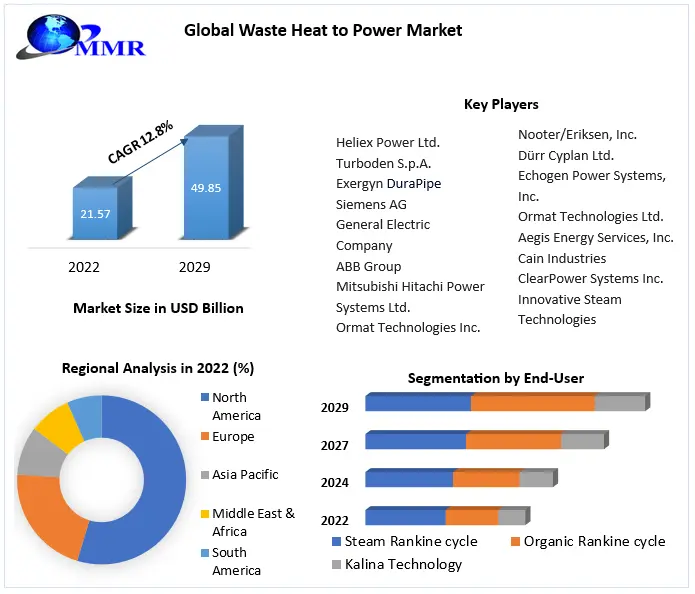
Waste Heat to Power (WHP) Market is poised for significant expansion, projected to grow from USD 21.57 billion in 2022 to USD 49.85 billion by 2029, at a CAGR of 12.8%. This growth is largely fueled by increasing energy efficiency requirements, climate change mitigation policies, and rising energy costs globally. Waste heat—typically lost in industrial processes—is being recognized as a valuable resource for clean power generation, reducing operational costs and greenhouse gas emissions.
Request free Sample Report:https://www.maximizemarketresearch.com/request-sample/209373/
Market Growth Drivers and Opportunities
Governments and corporations alike are embracing WHP systems to recover energy from industrial operations such as metal production, cement manufacturing, oil refining, and chemicals. The shift toward decarbonization and sustainable development goals has accelerated the deployment of technologies like Organic Rankine Cycles (ORC), Steam Rankine Cycles (SRC), and Kalina cycles. Among these, ORC stands out for its ability to efficiently harness low- to medium-temperature heat.
Emerging opportunities include:
Industrial Decarbonization: As companies commit to net-zero targets, WHP is becoming a strategic solution to reduce Scope 1 emissions.
Power Recovery in Data Centers and District Heating: Innovations are enabling data centers to route waste heat into residential heating systems, particularly in colder regions.
Modular and Small-Scale WHP Systems: These are gaining popularity for off-grid and remote industrial setups.
Thermoelectric Generators (TEGs): Although still niche, TEGs are growing in relevance for automotive, aerospace, and low-power industrial applications.
U.S. Market Trends and Investment (2024–2025)
In the United States, recent legislative support for energy efficiency—especially through the Inflation Reduction Act—has spurred investment in WHP systems. In 2024, multiple projects were initiated in sectors like steel, refining, and cement. Notably, partnerships between state energy offices and private operators have emerged to pilot WHP systems tied to district heating and grid balancing.
Industrial facilities in Texas, Ohio, and Pennsylvania have also begun retrofitting their older systems with ORC modules. The U.S. Department of Energy continues to fund research into enhancing conversion efficiency and integrating WHP with renewables and smart grids, underlining the country's commitment to reclaiming lost energy.
Market Segmentation – Leading Segments by Share
According to Maximize Market Research, the Organic Rankine Cycle (ORC) dominates the technology segment. It is particularly effective in low-temperature industrial applications and has seen rapid adoption across both developed and emerging economies.
In terms of end-user industries:
Cement holds the largest market share, thanks to its consistent high-temperature processes and global production footprint.
Other key sectors include chemical, oil and gas, pulp and paper, and ferrous and non-ferrous metals, all of which present favorable conditions for energy recovery and cost optimization.
Competitive Landscape – Top 5 Players Shaping the Market
The global WHP market is moderately consolidated with major players making substantial investments in R&D, partnerships, and system integration to remain competitive.
Siemens AG – A global pioneer in energy systems, Siemens has expanded its WHP product line to include hybrid systems and AI-based monitoring tools. In 2024, Siemens introduced an advanced ORC turbine designed for high-dust environments, further expanding its reach in cement and mining sectors.
General Electric (GE) – GE has focused on combining WHP with digital twin technology to optimize system performance and predictive maintenance. The company recently signed contracts in Southeast Asia and Eastern Europe to retrofit chemical plants with WHP capabilities.
ABB Ltd. – Known for its automation and electrical integration, ABB recently rolled out WHP-compatible smart grid solutions, enabling industrial sites to sell excess recovered power **** to the grid.
Ormat Technologies Inc. – Ormat remains a specialist in ORC systems for geothermal and industrial markets. In 2024, the company launched a modular WHP platform designed for quick deployment and scalability, targeting SMEs in the food and beverage industry.
Mitsubishi Heavy Industries – With its expertise in large-scale industrial equipment, Mitsubishi recently collaborated with European refineries to install Kalina cycle systems for high-efficiency heat recovery. Their new systems boast improved energy-to-emissions ratios, essential for EU compliance.
These companies are not only driving innovation but are also advocating for policy frameworks that support industrial decarbonization through WHP technologies.
Regional Analysis – U.S., UK, Germany, France, Japan, and China
United States: As the second-largest market globally, the U.S. has ramped up investment in WHP as part of its broader clean energy agenda. State-level grants, federal tax incentives, and high energy costs make WHP an attractive option for industrial retrofits.
United Kingdom: The UK is exploring the integration of WHP into its district heating networks. Waste heat from industrial clusters and data centers is being redirected into urban heating systems—a model gaining traction post-2024 as part of the UK’s “Net Zero Industry” strategy.
Germany: A frontrunner in WHP adoption, Germany benefits from strong regulatory pressure and industrial infrastructure. Its “Energy Efficiency First” policy has led to an increase in ORC installations in the manufacturing and recycling sectors.
France: Government support through low-interest loans and carbon-reduction mandates has made WHP adoption more feasible in the cement and glass manufacturing industries.
Japan: With limited natural resources and high energy prices, Japan is investing heavily in WHP technologies. The country emphasizes compact and modular systems that can be installed in smaller industrial settings.
China: Holding the largest global market share, China continues to dominate due to massive investments in energy recovery infrastructure across steel, cement, and petrochemical sectors. National subsidies and carbon intensity targets are further encouraging adoption.
Conclusion and Outlook
The Waste Heat to Power market is emerging as a cornerstone of sustainable industrial transformation. With increasing demand for low-carbon technologies and strict emissions regulations, WHP offers a proven pathway for industries to improve energy efficiency and reduce environmental impact.
Related Report:
Mechanical electrical and plumbing software market:https://www.maximizemarketresearch.com/market-report/mechanical-electrical-and-plumbing-software-market/190814/
Text to video ai market:https://www.maximizemarketresearch.com/market-report/text-to-video-ai-market/190642/
About Us
Maximize Market Research is one of the fastest-growing market research and business consulting firms serving clients globally. Our revenue impact and focused growth-driven research initiatives make us a proud partner of majority of the Fortune 500 companies. We have a diversified portfolio and serve a variety of industries such as IT & telecom, chemical, food & beverage, aerospace & defense, healthcare and others.
MAXIMIZE MARKET RESEARCH PVT. LTD.
2nd Floor, Navale IT park Phase 3,
Pune Banglore Highway, Narhe
Pune, Maharashtra 411041, India.
+91 9607365656
sales@maximizemarketresearch.com
Waste Heat to Power Market Set to Reach USD 49.85 Billion by 2029, Driven by Clean Energy Initiatives and Industrial Efficiency Demands
Waste Heat to Power (WHP) Market is poised for significant expansion, projected to grow from USD 21.57 billion in 2022 to USD 49.85 billion by 2029, at a CAGR of 12.8%. This growth is largely fueled by increasing energy efficiency requirements, climate change mitigation policies, and rising energy costs globally. Waste heat—typically lost in industrial processes—is being recognized as a valuable resource for clean power generation, reducing operational costs and greenhouse gas emissions.
Request free Sample Report:https://www.maximizemarketresearch.com/request-sample/209373/
Market Growth Drivers and Opportunities
Governments and corporations alike are embracing WHP systems to recover energy from industrial operations such as metal production, cement manufacturing, oil refining, and chemicals. The shift toward decarbonization and sustainable development goals has accelerated the deployment of technologies like Organic Rankine Cycles (ORC), Steam Rankine Cycles (SRC), and Kalina cycles. Among these, ORC stands out for its ability to efficiently harness low- to medium-temperature heat.
Emerging opportunities include:
Industrial Decarbonization: As companies commit to net-zero targets, WHP is becoming a strategic solution to reduce Scope 1 emissions.
Power Recovery in Data Centers and District Heating: Innovations are enabling data centers to route waste heat into residential heating systems, particularly in colder regions.
Modular and Small-Scale WHP Systems: These are gaining popularity for off-grid and remote industrial setups.
Thermoelectric Generators (TEGs): Although still niche, TEGs are growing in relevance for automotive, aerospace, and low-power industrial applications.
U.S. Market Trends and Investment (2024–2025)
In the United States, recent legislative support for energy efficiency—especially through the Inflation Reduction Act—has spurred investment in WHP systems. In 2024, multiple projects were initiated in sectors like steel, refining, and cement. Notably, partnerships between state energy offices and private operators have emerged to pilot WHP systems tied to district heating and grid balancing.
Industrial facilities in Texas, Ohio, and Pennsylvania have also begun retrofitting their older systems with ORC modules. The U.S. Department of Energy continues to fund research into enhancing conversion efficiency and integrating WHP with renewables and smart grids, underlining the country's commitment to reclaiming lost energy.
Market Segmentation – Leading Segments by Share
According to Maximize Market Research, the Organic Rankine Cycle (ORC) dominates the technology segment. It is particularly effective in low-temperature industrial applications and has seen rapid adoption across both developed and emerging economies.
In terms of end-user industries:
Cement holds the largest market share, thanks to its consistent high-temperature processes and global production footprint.
Other key sectors include chemical, oil and gas, pulp and paper, and ferrous and non-ferrous metals, all of which present favorable conditions for energy recovery and cost optimization.
Competitive Landscape – Top 5 Players Shaping the Market
The global WHP market is moderately consolidated with major players making substantial investments in R&D, partnerships, and system integration to remain competitive.
Siemens AG – A global pioneer in energy systems, Siemens has expanded its WHP product line to include hybrid systems and AI-based monitoring tools. In 2024, Siemens introduced an advanced ORC turbine designed for high-dust environments, further expanding its reach in cement and mining sectors.
General Electric (GE) – GE has focused on combining WHP with digital twin technology to optimize system performance and predictive maintenance. The company recently signed contracts in Southeast Asia and Eastern Europe to retrofit chemical plants with WHP capabilities.
ABB Ltd. – Known for its automation and electrical integration, ABB recently rolled out WHP-compatible smart grid solutions, enabling industrial sites to sell excess recovered power **** to the grid.
Ormat Technologies Inc. – Ormat remains a specialist in ORC systems for geothermal and industrial markets. In 2024, the company launched a modular WHP platform designed for quick deployment and scalability, targeting SMEs in the food and beverage industry.
Mitsubishi Heavy Industries – With its expertise in large-scale industrial equipment, Mitsubishi recently collaborated with European refineries to install Kalina cycle systems for high-efficiency heat recovery. Their new systems boast improved energy-to-emissions ratios, essential for EU compliance.
These companies are not only driving innovation but are also advocating for policy frameworks that support industrial decarbonization through WHP technologies.
Regional Analysis – U.S., UK, Germany, France, Japan, and China
United States: As the second-largest market globally, the U.S. has ramped up investment in WHP as part of its broader clean energy agenda. State-level grants, federal tax incentives, and high energy costs make WHP an attractive option for industrial retrofits.
United Kingdom: The UK is exploring the integration of WHP into its district heating networks. Waste heat from industrial clusters and data centers is being redirected into urban heating systems—a model gaining traction post-2024 as part of the UK’s “Net Zero Industry” strategy.
Germany: A frontrunner in WHP adoption, Germany benefits from strong regulatory pressure and industrial infrastructure. Its “Energy Efficiency First” policy has led to an increase in ORC installations in the manufacturing and recycling sectors.
France: Government support through low-interest loans and carbon-reduction mandates has made WHP adoption more feasible in the cement and glass manufacturing industries.
Japan: With limited natural resources and high energy prices, Japan is investing heavily in WHP technologies. The country emphasizes compact and modular systems that can be installed in smaller industrial settings.
China: Holding the largest global market share, China continues to dominate due to massive investments in energy recovery infrastructure across steel, cement, and petrochemical sectors. National subsidies and carbon intensity targets are further encouraging adoption.
Conclusion and Outlook
The Waste Heat to Power market is emerging as a cornerstone of sustainable industrial transformation. With increasing demand for low-carbon technologies and strict emissions regulations, WHP offers a proven pathway for industries to improve energy efficiency and reduce environmental impact.
Related Report:
Mechanical electrical and plumbing software market:https://www.maximizemarketresearch.com/market-report/mechanical-electrical-and-plumbing-software-market/190814/
Text to video ai market:https://www.maximizemarketresearch.com/market-report/text-to-video-ai-market/190642/
About Us
Maximize Market Research is one of the fastest-growing market research and business consulting firms serving clients globally. Our revenue impact and focused growth-driven research initiatives make us a proud partner of majority of the Fortune 500 companies. We have a diversified portfolio and serve a variety of industries such as IT & telecom, chemical, food & beverage, aerospace & defense, healthcare and others.
MAXIMIZE MARKET RESEARCH PVT. LTD.
2nd Floor, Navale IT park Phase 3,
Pune Banglore Highway, Narhe
Pune, Maharashtra 411041, India.
+91 9607365656
sales@maximizemarketresearch.com
The Waste Heat to Power Market Size, Price, Trends, Growth, Analysis, Report, Forecast 2023-2029
Waste Heat to Power Market Set to Reach USD 49.85 Billion by 2029, Driven by Clean Energy Initiatives and Industrial Efficiency Demands
Waste Heat to Power (WHP) Market is poised for significant expansion, projected to grow from USD 21.57 billion in 2022 to USD 49.85 billion by 2029, at a CAGR of 12.8%. This growth is largely fueled by increasing energy efficiency requirements, climate change mitigation policies, and rising energy costs globally. Waste heat—typically lost in industrial processes—is being recognized as a valuable resource for clean power generation, reducing operational costs and greenhouse gas emissions.
Request free Sample Report:https://www.maximizemarketresearch.com/request-sample/209373/
Market Growth Drivers and Opportunities
Governments and corporations alike are embracing WHP systems to recover energy from industrial operations such as metal production, cement manufacturing, oil refining, and chemicals. The shift toward decarbonization and sustainable development goals has accelerated the deployment of technologies like Organic Rankine Cycles (ORC), Steam Rankine Cycles (SRC), and Kalina cycles. Among these, ORC stands out for its ability to efficiently harness low- to medium-temperature heat.
Emerging opportunities include:
Industrial Decarbonization: As companies commit to net-zero targets, WHP is becoming a strategic solution to reduce Scope 1 emissions.
Power Recovery in Data Centers and District Heating: Innovations are enabling data centers to route waste heat into residential heating systems, particularly in colder regions.
Modular and Small-Scale WHP Systems: These are gaining popularity for off-grid and remote industrial setups.
Thermoelectric Generators (TEGs): Although still niche, TEGs are growing in relevance for automotive, aerospace, and low-power industrial applications.
U.S. Market Trends and Investment (2024–2025)
In the United States, recent legislative support for energy efficiency—especially through the Inflation Reduction Act—has spurred investment in WHP systems. In 2024, multiple projects were initiated in sectors like steel, refining, and cement. Notably, partnerships between state energy offices and private operators have emerged to pilot WHP systems tied to district heating and grid balancing.
Industrial facilities in Texas, Ohio, and Pennsylvania have also begun retrofitting their older systems with ORC modules. The U.S. Department of Energy continues to fund research into enhancing conversion efficiency and integrating WHP with renewables and smart grids, underlining the country's commitment to reclaiming lost energy.
Market Segmentation – Leading Segments by Share
According to Maximize Market Research, the Organic Rankine Cycle (ORC) dominates the technology segment. It is particularly effective in low-temperature industrial applications and has seen rapid adoption across both developed and emerging economies.
In terms of end-user industries:
Cement holds the largest market share, thanks to its consistent high-temperature processes and global production footprint.
Other key sectors include chemical, oil and gas, pulp and paper, and ferrous and non-ferrous metals, all of which present favorable conditions for energy recovery and cost optimization.
Competitive Landscape – Top 5 Players Shaping the Market
The global WHP market is moderately consolidated with major players making substantial investments in R&D, partnerships, and system integration to remain competitive.
Siemens AG – A global pioneer in energy systems, Siemens has expanded its WHP product line to include hybrid systems and AI-based monitoring tools. In 2024, Siemens introduced an advanced ORC turbine designed for high-dust environments, further expanding its reach in cement and mining sectors.
General Electric (GE) – GE has focused on combining WHP with digital twin technology to optimize system performance and predictive maintenance. The company recently signed contracts in Southeast Asia and Eastern Europe to retrofit chemical plants with WHP capabilities.
ABB Ltd. – Known for its automation and electrical integration, ABB recently rolled out WHP-compatible smart grid solutions, enabling industrial sites to sell excess recovered power back to the grid.
Ormat Technologies Inc. – Ormat remains a specialist in ORC systems for geothermal and industrial markets. In 2024, the company launched a modular WHP platform designed for quick deployment and scalability, targeting SMEs in the food and beverage industry.
Mitsubishi Heavy Industries – With its expertise in large-scale industrial equipment, Mitsubishi recently collaborated with European refineries to install Kalina cycle systems for high-efficiency heat recovery. Their new systems boast improved energy-to-emissions ratios, essential for EU compliance.
These companies are not only driving innovation but are also advocating for policy frameworks that support industrial decarbonization through WHP technologies.
Regional Analysis – U.S., UK, Germany, France, Japan, and China
United States: As the second-largest market globally, the U.S. has ramped up investment in WHP as part of its broader clean energy agenda. State-level grants, federal tax incentives, and high energy costs make WHP an attractive option for industrial retrofits.
United Kingdom: The UK is exploring the integration of WHP into its district heating networks. Waste heat from industrial clusters and data centers is being redirected into urban heating systems—a model gaining traction post-2024 as part of the UK’s “Net Zero Industry” strategy.
Germany: A frontrunner in WHP adoption, Germany benefits from strong regulatory pressure and industrial infrastructure. Its “Energy Efficiency First” policy has led to an increase in ORC installations in the manufacturing and recycling sectors.
France: Government support through low-interest loans and carbon-reduction mandates has made WHP adoption more feasible in the cement and glass manufacturing industries.
Japan: With limited natural resources and high energy prices, Japan is investing heavily in WHP technologies. The country emphasizes compact and modular systems that can be installed in smaller industrial settings.
China: Holding the largest global market share, China continues to dominate due to massive investments in energy recovery infrastructure across steel, cement, and petrochemical sectors. National subsidies and carbon intensity targets are further encouraging adoption.
Conclusion and Outlook
The Waste Heat to Power market is emerging as a cornerstone of sustainable industrial transformation. With increasing demand for low-carbon technologies and strict emissions regulations, WHP offers a proven pathway for industries to improve energy efficiency and reduce environmental impact.
Related Report:
Mechanical electrical and plumbing software market:https://www.maximizemarketresearch.com/market-report/mechanical-electrical-and-plumbing-software-market/190814/
Text to video ai market:https://www.maximizemarketresearch.com/market-report/text-to-video-ai-market/190642/
About Us
Maximize Market Research is one of the fastest-growing market research and business consulting firms serving clients globally. Our revenue impact and focused growth-driven research initiatives make us a proud partner of majority of the Fortune 500 companies. We have a diversified portfolio and serve a variety of industries such as IT & telecom, chemical, food & beverage, aerospace & defense, healthcare and others.
MAXIMIZE MARKET RESEARCH PVT. LTD.
2nd Floor, Navale IT park Phase 3,
Pune Banglore Highway, Narhe
Pune, Maharashtra 411041, India.
+91 9607365656
sales@maximizemarketresearch.com
0 Comments
0 Shares
475 Views
0 Reviews


 Arabic
 Français
 Español
 Português
 Deutsch
 Türkçe
 Dutch
Dutch
 Italiano
 Russian
 Romaian