


How a Simple WhatsApp Chatbot Solved a Big Problem for Hospitals
When people talk about better healthcare, they usually talk about new machines, better medicines, or skilled doctors. Nobody talks about the front desk. But the front desk is where a patient's journey actually begins, and if that first step is broken, everything after it suffers too.
This is exactly the problem that came up for Simplex Himes, an IT service company working with hospitals across the Middle East and Africa. Their software was doing a great job of managing hospital operations from the inside. But there was one weak point they could not ignore: the appointment booking process.
To fix this, they teamed up with Anantya.ai, a company known for building smart WhatsApp automation tools. Together, they created a simple but powerful system that changed how patients book their appointments. This article breaks down what the problem was, how it was solved, and what results came out of it.
The Real Problem Was Never Medical Care
Simplex Himes worked with hospitals that had strong medical teams and good internal systems. The doctors were skilled. The treatment was solid. So where was the issue?
It was in the small, everyday moments before a patient even reached the hospital.
Simplex Himes understood something important here. This was never a medical problem. It was a communication problem. Their software could handle everything happening inside the hospital, but the very first door a patient walked through was still stuck.
Why WhatsApp Was the Right Answer
When Simplex Himes approached Anantya, they had one clear requirement. The solution had to work without any training. Patients should not need to download a new app, sign up for an account, or learn how to use a new system.
The answer was simpler than expected. It was already sitting on almost every patient's phone.
Here is how the entire process was designed, step by step:
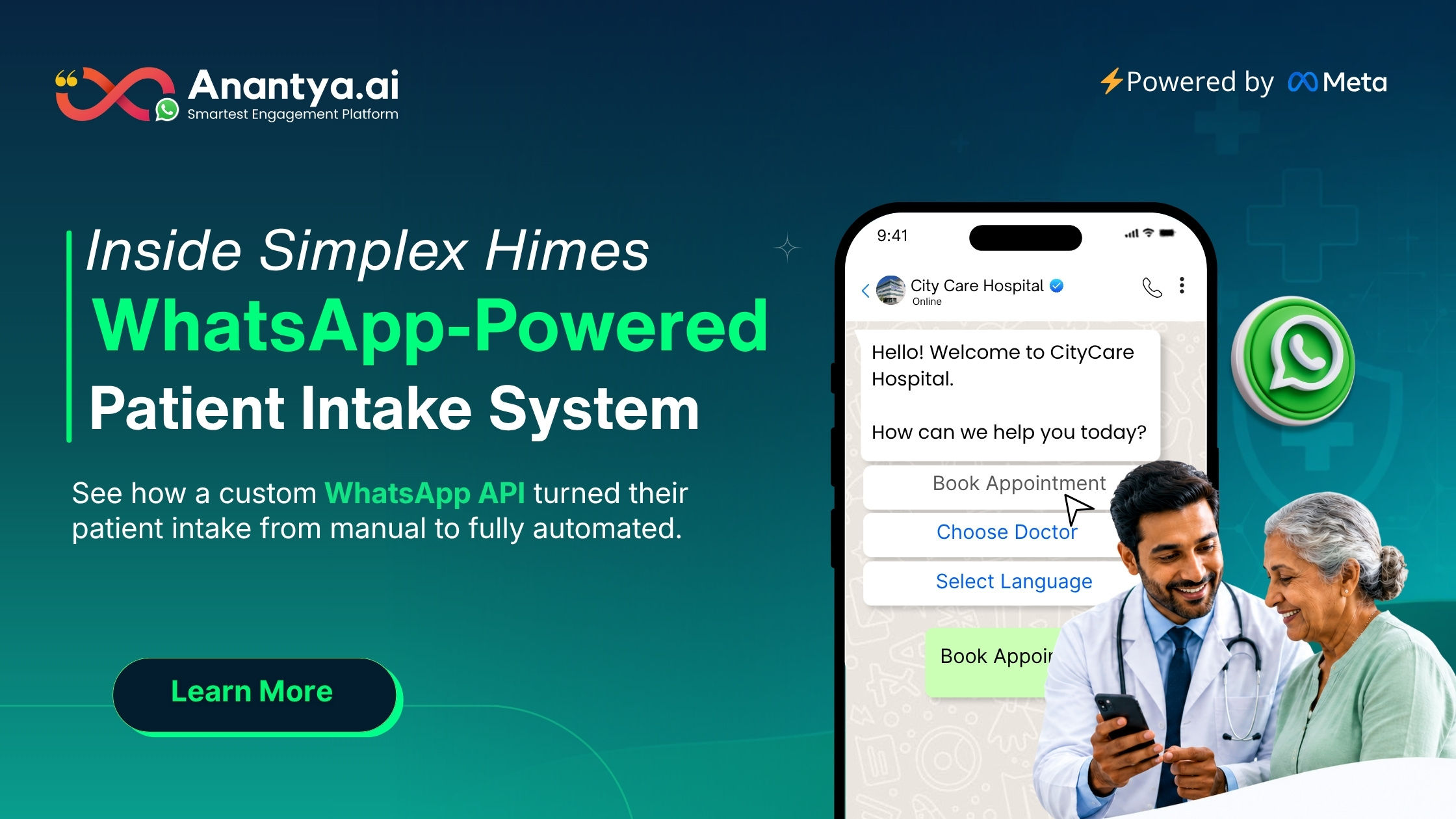
Step 1: The patient starts the conversation. A patient simply sends a WhatsApp message to the hospital's official business number. No app download. No new login.
Step 2: The chatbot asks simple questions The chatbot asks a few easy questions. What is your name? Which department do you need? What time works best for you? The tone feels like a normal conversation, not a form.
Step 3: Real-time slot checking through custom APIs This is where the real technical work happened. Anantya built a custom API connection between the WhatsApp chatbot and the hospital's existing appointment system. So when a patient picks a time, the bot checks live availability right away and confirms the booking instantly.
Step 4: Instant confirmation on WhatsApp As soon as the slot is booked, the patient gets a confirmation message with all the details. The doctor's name, the department, the time, and any instructions before the visit.
Step 5: Automatic reminders A day before the appointment, the system sends a friendly reminder. Patients can confirm, change the time, or cancel, all within the same WhatsApp chat.
The best part is that none of the hospital's existing systems had to be replaced. Anantya simply built a bridge that connected WhatsApp to what was already working.
Building This Was Not as Easy as It Sounds
Two big challenges came up during this project.
The first challenge was purely technical. Hospital management systems are usually closed off on purpose. They are built for internal, secure use, not for outside connections. So creating a safe and reliable custom API that could talk to the hospital's system without disturbing anything else took careful planning. The Anantya team mapped out the entire data flow before writing a single line of code, making sure every booking made through WhatsApp matched perfectly with the hospital's internal calendar.
Language mattered too. Since the hospitals served patients from many different backgrounds, the chatbot was built to detect and respond in the patient's preferred language right from the very first message. This removed yet another barrier between the patient and their appointment.
From building the API to designing the chatbot conversation and testing everything, the whole project was completed and running within just a few weeks.
What Changed After the Chatbot Went Live
The results showed up quickly, and they were noticeable.
Booking time dropped a lot. What used to take multiple phone calls and manual notes now happened in a single WhatsApp chat, often finished in under three minutes.
Front desk calls reduced sharply. Staff who used to spend most of their day answering booking calls suddenly had **** more free time. That time was redirected toward actually helping patients who were physically at the hospital.
Fewer patients missed their appointments. The automatic WhatsApp reminders made a real difference. Patients who got a reminder a day before were far more likely to either show up or reschedule early, which meant the slot did not go to waste.
Patients were happier overall. The feedback was simple and consistent. People liked being able to book an appointment at any time of day, without waiting on hold, using an app they already trusted.
Hospital staff felt the change too. The front desk stopped being a stressful bottleneck. It finally became what it was always meant to be, a place of care instead of a place of friction.
Every Hospital Has a Different Problem, But the Fix Can Still Be Simple
This particular story is about appointment booking. But the bigger lesson here applies to almost any healthcare provider. Somewhere in every patient's journey, there is a slow, manual, outdated step that is quietly costing time, trust, and patients.
If your business, whether in healthcare or any other industry, deals with repeated manual steps, missed follow-ups, or slow customer intake, there is likely a similar solution that fits your situation too.
For more information kindly read the full blog - https://anantya.ai/blog/whatsapp-chatbot-for-hospitals-case-study/


 Arabic
 Français
 Español
 Português
 Deutsch
 Türkçe
 Dutch
Dutch
 Italiano
 Russian
 Romaian