


Pneumatic vs. Self-Operated Control Valves: A Comprehensive Comparison
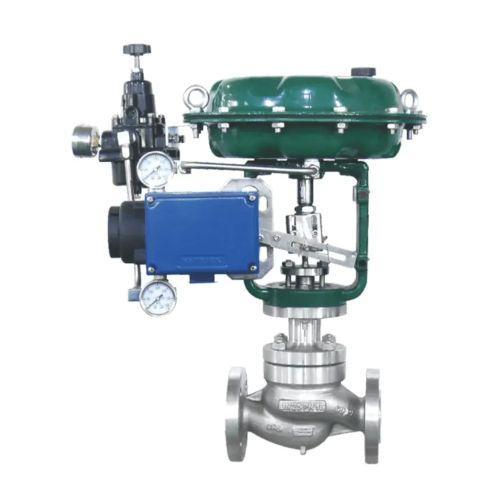
Pneumatic vs. Self-Operated China Control Valves: A Comprehensive Comparison
Introduction
In process automation and fluid control, selecting the right control valve is essential for achieving precise performance, safety, and efficiency. Among the many types available, pneumatic control valves and self-operated control valves are frequently compared due to their widespread use and distinct characteristics.
Each valve type offers specific advantages and is best suited to different operational scenarios. This article provides a detailed comparison between pneumatic and self-operated control valves—examining their operating principles, control capabilities, installation requirements, and ideal applications—to help engineers and plant operators make informed decisions.
What is a Pneumatic Control Valve?
A pneumatic control valve uses compressed air and external control signals to modulate the flow of fluid through a pipeline. It typically consists of:
-
A valve body
-
A pneumatic actuator
-
A positioner (optional but common for precision control)
These valves are integrated into a larger control system, such as a DCS (Distributed Control System) or PLC (Programmable Logic Controller). They respond to electrical or pneumatic signals (e.g., 4–20 mA or 0.2–1 bar), which direct the actuator to adjust the valve’s position and regulate process parameters like flow, pressure, or temperature.
Key Features:
-
Requires external air supply and control signal
-
Enables fast, dynamic responses
-
High precision and accuracy
-
Suitable for complex automation and feedback loops
What is a Self-Operated Control Valve?
A self-operated control valve operates independently, without external power or signal input. It relies solely on the process medium’s own pressure or temperature to drive valve actuation. Internal mechanisms such as diaphragms, bellows, and springs adjust the valve position in response to changing system conditions.
These valves are ideal for applications where utility infrastructure is limited or where control needs are stable and predictable.
Key Features:
-
Operates autonomously
-
No external power or control system required
-
Cost-effective and low maintenance
-
Ideal for basic, static control requirements
Pneumatic vs. Self-Operated Control Valves: Key Comparisons
1. Power Source and Control Method
-
Pneumatic: Requires compressed air and control signals from an external system. Suitable for remote, automated control.
-
Self-Operated: Uses the medium’s own energy (pressure/temperature) for actuation. Completely self-contained.
✔ Verdict: Pneumatic valves are ideal for centralized, automated systems. Self-operated valves are better for remote or standalone installations.
2. Control Accuracy
-
Pneumatic: High control precision (typically ±0.3% to ±0.5%) with excellent feedback and modulation.
-
Self-Operated: Moderate accuracy (±5% to ±10%) due to mechanical limitations and response lag.
✔ Verdict: Choose pneumatic for fine-tuned control. Self-operated valves are best for broad-range adjustments.
3. Adjustment Flexibility
-
Pneumatic: Setpoints can be modified remotely in real-time through control software.
-
Self-Operated: Manual on-site adjustments only, often requiring mechanical tuning of springs or regulators.
✔ Verdict: Pneumatic valves excel in dynamic environments; self-operated valves work well for "set-and-forget" scenarios.
4. Installation and Maintenance
-
Pneumatic: Requires air lines, signal wiring, and regular servicing of actuators and positioners.
-
Self-Operated: Simple to install, with minimal infrastructure and maintenance requirements.
✔ Verdict: Self-operated valves offer a plug-and-play solution for remote or low-maintenance systems.
5. Design and Layout Requirements
-
Pneumatic: More flexible in orientation and pipeline configuration.
-
Self-Operated: Requires careful orientation for sensing. For example:
-
In steam systems: Install actuator downward, with a condenser in place
-
In gas systems: Pressure tapping must be from the pipe’s top section
-
✔ Verdict: Pneumatic valves are more versatile; self-operated valves demand precise layout for proper function.
6. Application Scenarios
Pneumatic Valve Applications:
-
Chemical and petrochemical processing
-
Power plants (boilers, turbines)
-
Water treatment and desalination systems
-
Industrial automation and control loops
-
HVAC systems with centralized control
Self-Operated Valve Applications:
-
Pressure-reducing stations
-
Local steam heating systems
-
Lubrication and auxiliary fluid systems
-
Natural gas distribution with limited infrastructure
-
Remote sites without electrical or pneumatic supply
When to Choose Each Type
✅ Choose a Pneumatic Control Valve if:
-
You need high precision and responsiveness
-
The plant has a centralized control system
-
Process parameters vary frequently
-
Remote monitoring or adaptive control is required
-
The medium is demanding (corrosive, viscous, high-pressure)
✅ Choose a Self-Operated Control Valve if:
-
The system is stable and infrequently adjusted
-
There is no air or power supply available
-
You're seeking a cost-effective, low-maintenance solution
-
The installation site is remote or hard to access
-
Control demands are basic and local-only
Quick Reference Table: Pneumatic vs. Self-Operated Valves
| Feature | Pneumatic Control Valve | Self-Operated Control Valve |
|---|---|---|
| Power Source | External (Compressed air + signal) | Internal (Process pressure/temperature) |
| Control Accuracy | High (±0.3%–0.5%) | Moderate (±5%–10%) |
| Control Method | Remote (via DCS/PLC) | Local only |
| Adjustment Flexibility | Dynamic, real-time | Manual, on-site |
| System Complexity | Higher (with instrumentation) | Lower (standalone) |
| Installation | Requires infrastructure | Minimal requirements |
| Maintenance | Periodic servicing required | Low maintenance |
| Typical Applications | Automation, precision processes | Stable, standalone systems |
Conclusion
Both pneumatic and self-operated control valves are integral to fluid control systems, each fulfilling different operational roles. Pneumatic valves offer high precision, remote control, and real-time adaptability—making them indispensable for automated and variable process environments. In contrast, self-operated valves provide simplicity, reliability, and autonomy, making them ideal for static systems and remote locations.
When selecting between the two, consider the control needs, system complexity, infrastructure availability, and cost of ownership. Aligning your valve choice with these parameters will ensure optimal performance, process efficiency, and long-term reliability.Learn more about Google SEO.
 Deutsch
 English
 Arabic
 Français
 Español
 Português
 Türkçe
 Dutch
Dutch
 Italiano
 Russian
 Romaian