


Understanding Flow Measurement Devices: Types, Applications, and Selection Guide
Introduction
Accurate flow measurement is essential across industries — from chemical processing and water treatment to food manufacturing and research laboratories. Monitoring and controlling the movement of liquids or gases ensures efficiency, safety, and quality in every process. This is where Flow Measurement Devices come into play. These instruments help measure the rate at which fluid or gas moves through a system, offering data that supports better decision-making and process optimization.
What Are Flow Measurement Devices?
Flow measurement devices are instruments used to determine the quantity of a fluid (liquid or gas) passing through a pipeline over a given period. Measurements can be based on volume, mass, or velocity, depending on the technology and application.
They are widely used in:
-
Industrial automation and process control
-
Energy and utilities
-
Pharmaceutical and food industries
-
Research and development laboratories
By accurately measuring flow, these devices help improve production consistency, detect leaks, and maintain compliance with industry standards.
Common Types of Flow Measurement Devices
-
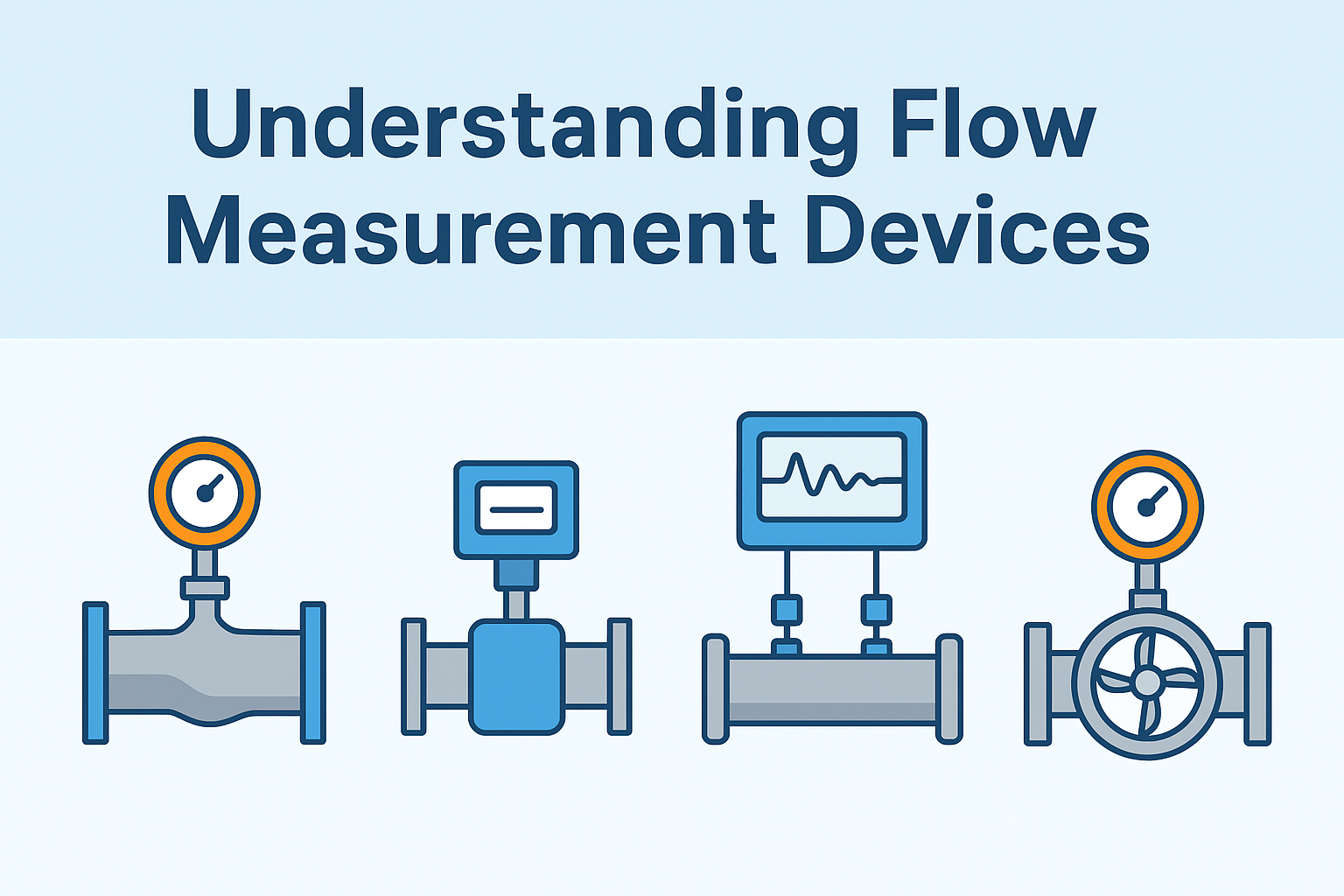
Differential Pressure Flow Meters
Measure flow by detecting pressure drop across an obstruction (like an orifice plate or venturi tube). Reliable and widely used for liquid, gas, and steam flow applications. -
Electromagnetic Flow Meters
Ideal for conductive liquids. These devices use a magnetic field to measure the flow rate, offering accuracy with minimal pressure loss. -
Ultrasonic Flow Meters
Utilize sound waves to determine fluid velocity. Non-invasive and suitable for clean or large-diameter pipelines. -
Turbine Flow Meters
Contain a rotor that spins as fluid passes through. The rotational speed corresponds to flow velocity. Common in fuel, water, and chemical measurement. -
Coriolis Mass Flow Meters
Measure the actual mass flow of a fluid, independent of its temperature, pressure, or density. Often used in applications requiring high accuracy. -
Thermal Flow Meters
Measure gas flow by detecting the rate of heat dissipation from a heated sensor. Ideal for low-flow or clean gas applications.
How to Choose the Right Flow Measurement Device
Selecting the right device depends on several factors. Consider the following before making your choice:
-
Fluid Type: Liquid, gas, or steam — and its properties like viscosity, conductivity, and density.
-
Flow Range: Minimum and maximum expected flow rates.
-
Accuracy Requirements: Some applications demand high precision, while others may allow approximate readings.
-
Operating Conditions: Temperature, pressure, and environmental factors that may affect performance.
-
Installation Requirements: Space availability, pipeline orientation, and ease of maintenance.
-
Signal Output: Compatibility with monitoring or control systems.
Choosing the right combination of technology and specifications ensures reliable, long-term performance and reduces downtime.
Applications of Flow Measurement Devices
These devices find use in a wide range of industries, including:
-
Water and wastewater treatment – for monitoring inflow and discharge rates.
-
Oil and gas – for measuring fuel, crude, or gas flow in pipelines.
-
Pharmaceuticals – for precise batching and quality assurance.
-
Food and beverage – to control ingredients and maintain product consistency.
-
HVAC and building systems – to measure airflow and energy efficiency.
In every application, the accuracy and reliability of flow data directly affect productivity, safety, and cost efficiency.
Benefits of Accurate Flow Measurement
Using reliable Flow Measurement Devices offers multiple advantages:
-
Improved process control and product quality
-
Reduced operational costs and waste
-
Enhanced safety and compliance with regulations
-
Real-time monitoring and data analysis for better decision-making
-
Optimized resource utilization and energy management
Conclusion
Flow measurement is a cornerstone of modern industrial operations. The right Flow Measurement Devices can transform how processes are monitored and controlled — ensuring precision, efficiency, and sustainability. Whether measuring liquids, gases, or steam, understanding device types, capabilities, and selection factors is key to achieving reliable and consistent results.

 English
 Arabic
 Français
 Español
 Português
 Deutsch
 Dutch
Dutch
 Italiano
 Russian
 Romaian