


Verification vs Validation in Software Testing: Understanding the Key Differences
Ensuring software quality requires more than writing code that works - it involves verifying that the product meets requirements and validating that it fulfills user needs. Verification vs validation are two fundamental concepts in software testing that serve complementary roles in achieving this goal. Understanding the differences helps teams prevent defects, deliver reliable software, and improve overall system quality.
This article explains the concepts, processes, and best practices for applying verification and validation effectively in modern software development.
What Is Verification in Software Testing?
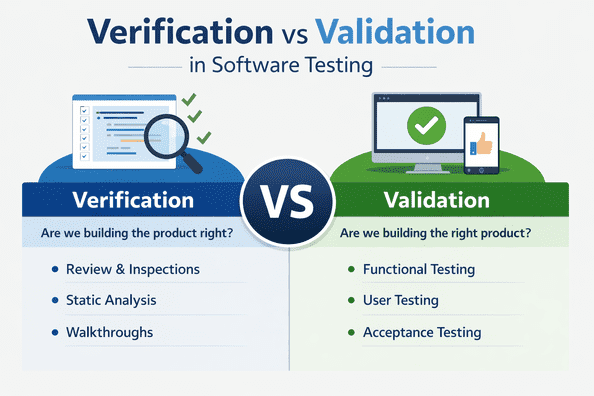
Verification is the process of evaluating software during development to ensure it complies with specified requirements and design specifications. The focus is on correctness, consistency, and completeness of the software artifacts before they are released.
Key aspects of verification include:
-
Reviewing requirements and design documents
-
Static testing such as code inspections, walkthroughs, and reviews
-
Ensuring the product is built according to defined specifications
Verification answers the question: “Are we building the product right?”
What Is Validation in Software Testing?
Validation, on the other hand, ensures that the final software product meets the intended use and fulfills user expectations. Validation is typically performed through dynamic testing, such as functional tests, system tests, and user acceptance tests.
Key aspects of validation include:
-
Running the software in real-world scenarios
-
Checking that features behave as intended
-
Verifying that the system meets business and user requirements
Validation answers the question: “Are we building the right product?”
Key Differences Between Verification and Validation
| Aspect | Verification | Validation |
|---|---|---|
| Focus | Process and requirements | Product and functionality |
| Timing | During development (early stages) | After implementation (later stages) |
| Approach | Static testing | Dynamic testing |
| Goal | Ensure the software is correctly built | Ensure the software meets user needs |
| Examples | Code reviews, design inspections | Functional testing, UAT, system testing |
How Verification and Validation Work Together
Both verification vs validation are essential for delivering high-quality software. While verification ensures that the development process is correct and follows specifications, validation ensures that the end product meets user expectations and performs reliably in production environments.
When applied together:
-
Verification prevents defects from being introduced during development
-
Validation catches issues that could affect end-user satisfaction
-
Combined, they reduce the risk of production failures and rework
Best Practices for Verification and Validation
-
Define requirements clearly: Ensure that both functional and non-functional requirements are well documented.
-
Use static and dynamic testing appropriately: Apply code reviews and walkthroughs for verification, and functional/system tests for validation.
-
Integrate into CI/CD pipelines: Early verification and continuous validation reduce the chances of defects reaching production.
-
Prioritize critical components: Focus efforts on high-risk features and workflows.
-
Maintain traceability: Link test cases to requirements to ensure both verification and validation cover all critical aspects.
Practical Application Scenarios
-
API Development: Verification ensures endpoints follow specifications; validation confirms that APIs behave correctly in real-world integrations.
-
UI/UX Testing: Verification checks design consistency; validation ensures user workflows are intuitive and functional.
-
Regression Testing: Verification ensures new code changes do not violate specifications; validation ensures existing functionality remains correct after updates.
Conclusion
Understanding verification vs validation is essential for teams aiming to deliver reliable, high-quality software. Verification focuses on building the product correctly, while validation ensures the product meets user expectations. By applying both principles in development workflows, integrating them into CI/CD pipelines, and prioritizing critical components, teams can reduce production defects, improve reliability, and maintain user satisfaction.
Both verification and validation are not optional - they are complementary practices that form the backbone of effective software quality assurance.

 Arabic
 Français
 Español
 Português
 Deutsch
 Türkçe
 Dutch
Dutch
 Italiano
 Russian
 Romaian