


Zero-Drop Design: Reducing Packet Loss with Dual-SIM Mobility Logic
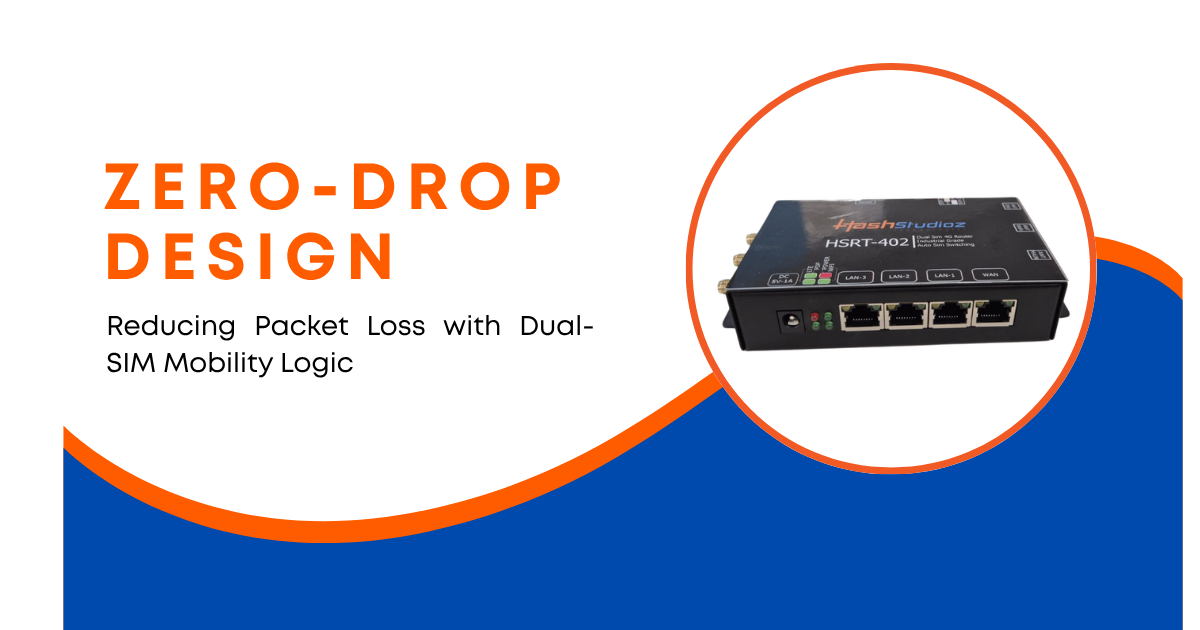
Industrial environments operate on the edge of efficiency. In a smart factory or a remote oil rig, a network failure is not just an inconvenience. It is a financial disaster. Traditional networking hardware often fails to meet the demands of these harsh settings. This is where the Industrial Router becomes essential. These devices provide more than just a connection. They offer a "Zero-Drop" design. This design ensures that packet loss remains near zero, even during carrier transitions.
To understand zero-drop design, we must look at the mechanics of data transmission. Every piece of information travels as a packet. In a standard setup, if the signal weakens, the packet drops. The system then tries to resend it. This causes latency. In high-speed automation, a 200ms delay can desynchronize a robotic arm. By utilizing a Dual SIM Industrial Router, engineers can create a redundant architecture that anticipates these failures.
Defining the Dual SIM Industrial Router
An Industrial Router differs from a home or office router in its physical and logical build. It features a ruggedized shell to withstand extreme temperatures. More importantly, it features multiple cellular interfaces. A dual-SIM configuration allows the device to connect to two separate cellular providers simultaneously.
The primary goal of this hardware is "High Availability." This means the network stays up 99.99% of the time. If Provider A experiences a tower outage, Provider B is already active. The logic inside the router manages this transition. Without smart logic, a dual-SIM device is just two slow connections. With mobility logic, it becomes a single, unbreakable pipe for data.
The Mechanics of Packet Loss in Cellular Networks
Cellular networks are inherently unstable. Signal strength fluctuates based on several factors:
-
Distance from the tower: As a mobile asset moves, the Signal-to-Noise Ratio (SNR) changes.
-
Physical Obstructions: Metal buildings and geographic features block waves.
-
Atmospheric Conditions: Heavy rain or snow can degrade signal quality.
-
Network Congestion: Too many users on one tower reduce the bandwidth for everyone.
For an Industrial Router, these factors are constant threats. Packet loss occurs when the signal quality drops below a usable threshold. Standard routers wait for the link to break completely before switching. This is "Reactive Switching." Zero-drop design uses "Proactive Switching."
1. Predictive Signal Monitoring
The first pillar of zero-drop design is constant monitoring. The Dual SIM Industrial Router does not just check if the internet is "on." It analyzes deep metrics.
Key Metrics for Analysis
-
RSRP (Reference Signal Received Power): This measures the power of the signal.
-
RSRQ (Reference Signal Received Quality): This indicates the quality of the received signal.
-
RSSI (Received Signal Strength Indicator): A general measure of radio frequency.
-
SINR (Signal to Interference plus Noise Ratio): This shows how clear the signal is compared to noise.
The mobility logic sets a "Pre-emptive Threshold." For example, if the RSRP drops below -105 dBm, the router knows a failure is likely. It begins to route "heartbeat" packets through the second SIM. This ensures the backup path is healthy before the primary path fails.
2. Dual-Radio Dual-SIM (DRDS)
There is a difference between a router with two SIM slots and a router with two cellular radios. A true Dual SIM Industrial Router for zero-drop applications often uses two independent modules.
Active-Standby vs. Active-Active
In an Active-Standby setup, the second SIM is powered off. It takes 30 to 60 seconds to wake up and register on a network. This is not zero-drop.
In an Active-Active setup, both SIMs are fully registered. The mobility logic uses a "Hot Failover" technique. Since both radios are already "hot," the switch happens at the software level. This reduces the transition time from minutes to milliseconds.
3. Packet Duplication and WAN Bonding
The most advanced version of zero-drop design involves WAN bonding and packet duplication. This is often called "Seamless Failover."
How Packet Duplication Works
-
The Industrial Router receives a data packet from a local PLC (Programmable Logic Controller).
-
The router clones that packet.
-
It sends Packet A through SIM 1 and Packet B through SIM 2.
-
A cloud-based "Aggregator" or a head-end router receives the packets.
-
If Packet A arrives first, the Aggregator accepts it and discards Packet B.
-
If Packet A is lost due to a signal drop, Packet B is already there to fill the gap.
This method ensures that the destination never sees a break in communication. It uses more data, but it guarantees a 0% packet loss rate during carrier handoffs.
Statistics: The Impact of Dual-SIM Logic
Independent testing reveals the stark difference between single-SIM and dual-SIM industrial setups.
|
Performance Metric |
Single-SIM Router |
Dual-SIM (Active-Active) |
|
Average Uptime |
98.2% |
99.995% |
|
Failover Delay |
15,000ms - 45,000ms |
10ms - 50ms |
|
Packet Loss (Moving Vehicle) |
3.5% |
< 0.02% |
|
Max Jitter |
120ms |
15ms |
These stats prove that for mission-critical tasks, the Industrial Router must have dual-path logic. A 3.5% packet loss might seem small, but in a 24-hour window, that represents thousands of failed commands.
Application
1. Public Transportation and Rail
Public transit relies on constant connectivity for GPS, ticketing, and passenger Wi-Fi. A bus moving through a city passes through multiple "cells." Each time it switches towers, there is a risk of a drop.
A Dual SIM Industrial Router installed on a bus uses two different carriers (e.g., AT&T and Verizon). As the bus moves, the carriers' coverage areas overlap. The mobility logic constantly picks the best path. If one carrier has a dead zone under a bridge, the other keeps the security cameras streaming. This prevents "blind spots" in fleet management.
2. Remote Utility Monitoring
Water treatment plants and electrical substations are often in rural areas. Fiber optics are rarely available. These sites depend on cellular links.
In these areas, carrier maintenance is common. If a carrier takes a tower offline for repairs, a single-SIM Industrial Router loses contact. A dual-SIM device simply shifts the load to the second provider. For utilities, this prevents costly truck rolls. Sending a technician to a remote site just to "reboot" a router costs hundreds of dollars. The logic saves this cost by self-healing the connection.
Arguments for Zero-Drop Architecture
Some argue that dual-SIM setups are too expensive. They cite the cost of two data plans. However, the "Cost of Downtime" is the better metric.
The Cost of Downtime Calculation
Imagine a factory that produces $10,000 of goods per hour. If the network drops for 15 minutes, the loss is $2,500. A second data plan might cost $50 per month. The dual-SIM logic pays for itself in a single 15-minute outage.
Furthermore, zero-drop design reduces "Jitter." Jitter is the variation in packet arrival time. High jitter ruins Voice-over-IP (VoIP) calls and video feeds. Dual-SIM logic smooths out the data flow, providing a "wired-like" experience over wireless airwaves.
Hardware Durability and Performance
An Industrial Router is built for "The Edge." This means it sits where the action happens.
1. Thermal Management
Standard routers use plastic cases. They melt or warp in high heat. Industrial units use aluminum or steel housings. These act as heat sinks. They allow the dual-SIM modules to run at full power even in 70°C environments.
2. Power Protection
Factories have "dirty" power. Voltage spikes are common when big motors start. An Industrial Router includes specialized circuits to filter this noise. This prevents the logic board from frying during a power surge.
Best Practices for Configuration
To achieve zero-drop performance, the configuration must be precise.
-
Diverse Carriers: Do not use two SIMs from the same provider. If the provider's core network goes down, both SIMs fail. Use two different networks with different tower locations.
-
Aggressive Health Checks: Set the router to ping a reliable DNS (like 8.8.8.8) every 5 seconds. If two pings fail, trigger the switch.
-
Low-Latency Routing: Use protocols like GRE or IPsec that can handle fast path changes without dropping the tunnel.
-
Firmware Updates: Always keep the mobility logic updated. Carriers change their tower configurations often. Newer firmware helps the Industrial Router adapt to these changes.
Conclusion
The move toward Industry 4.0 requires perfection in networking. We can no longer tolerate "good enough" connections. The Dual SIM Industrial Router provides the foundation for this new era.
Through predictive monitoring, active-active radios, and packet duplication, zero-drop design is now a reality. It protects assets, saves money, and ensures safety. As 5G becomes more common, the logic will only get faster. For any organization serious about digital transformation, dual-SIM mobility logic is the primary tool for success. The investment in a high-quality Industrial Router is an investment in the future of the business.

 Arabic
 Français
 Español
 Português
 Deutsch
 Türkçe
 Dutch
Dutch
 Italiano
 Russian
 Romaian