


Types of API Testing: Complete Guide for Modern Applications
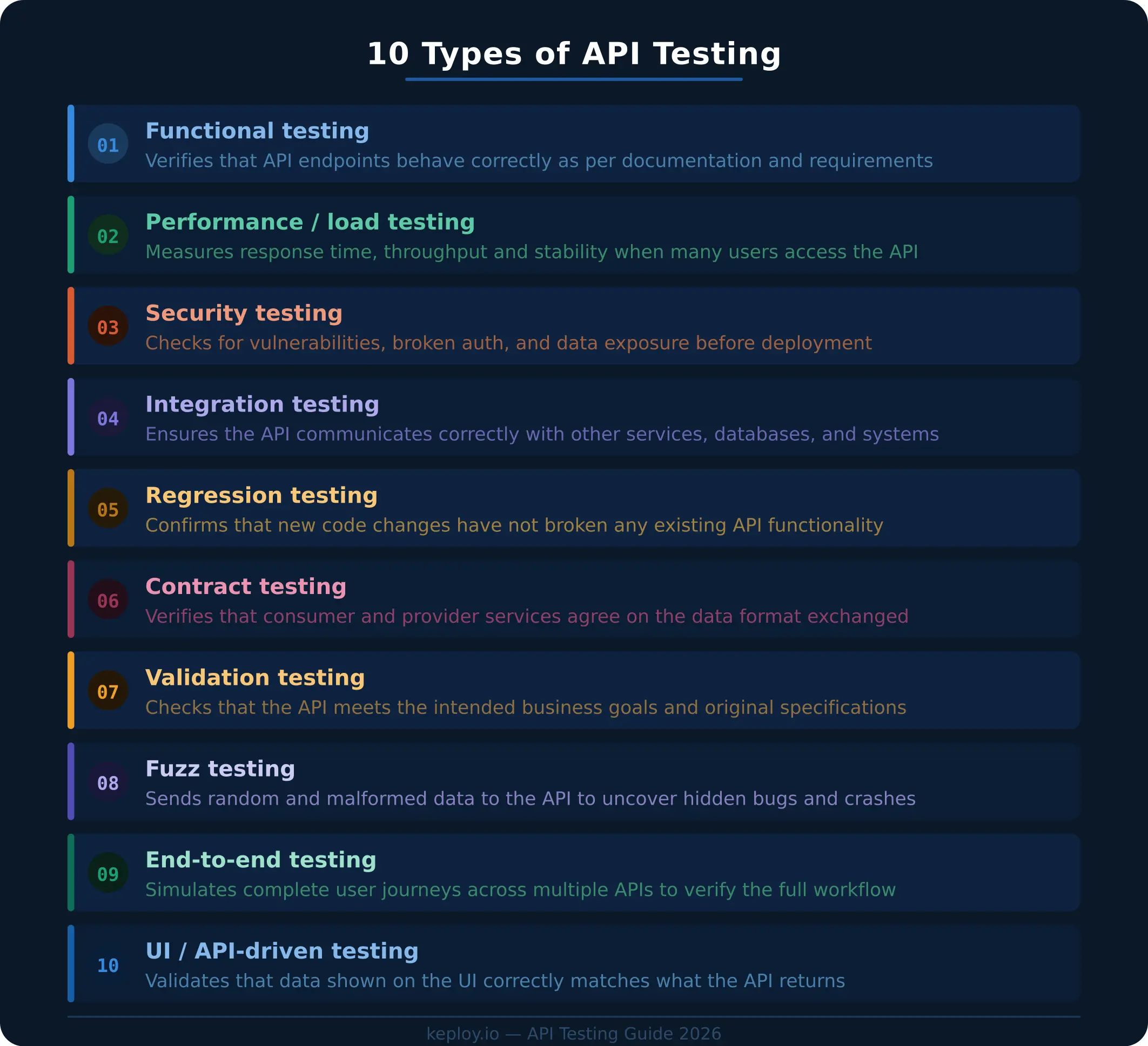
APIs are the backbone of modern software, enabling communication between services, applications, and systems. Ensuring they work correctly is critical—and that’s where understanding the types of API testing becomes essential. Each testing type targets a specific aspect of an API, from functionality to security and performance, helping teams deliver reliable and scalable applications.
In this guide, we’ll break down all major types of API testing, explain their importance, and show how they fit into a complete testing strategy. For a deeper dive, you can also explore this detailed resource on types of API testing.
What Are API Testing Types?
API testing types refer to different testing approaches used to validate an API’s behavior, performance, reliability, and security. Instead of focusing on the UI, API testing directly evaluates request-response interactions, business logic, and integrations.
There’s no fixed number of API testing types, but most experts agree on a core set that ensures comprehensive coverage.
Core Types of API Testing
1. Functional Testing
Functional testing verifies that the API works according to requirements. It checks whether endpoints return the correct responses for given inputs.
What it validates:
- Request and response accuracy
- Status codes (200, 404, 500, etc.)
- Business logic correctness
This is the most fundamental type and often the starting point of API testing.
2. Integration Testing
Integration testing ensures that the API interacts correctly with external systems like databases, microservices, or third-party APIs.
Why it matters:
APIs rarely work in isolation. Integration testing ensures smooth data flow across systems.
3. Performance Testing
Performance testing evaluates how well an API performs under different conditions such as high traffic or heavy loads.
Includes:
- Load testing
- Stress testing
- Spike testing
Goal: Ensure low latency and high reliability even during peak usage.
4. Security Testing
Security testing identifies vulnerabilities like unauthorized access, weak authentication, and data leaks.
Focus areas:
- Authentication & authorization
- Encryption
- Protection against attacks (SQL injection, XSS)
5. Contract Testing
Contract testing ensures that the API adheres to predefined schemas and agreements between services.
Example:
If one service expects a specific JSON format, contract testing ensures the API always delivers it.
6. Unit Testing
Unit testing focuses on individual API components or endpoints to ensure they function correctly in isolation.
Benefit:
Early bug detection during development.
7. Load Testing
Load testing checks how many requests an API can handle before performance degrades.
Use case:
Validating scalability before production deployment.
8. Regression Testing
Regression testing ensures that new updates or changes do not break existing functionality.
Essential for:
CI/CD pipelines and continuous delivery environments.
9. Smoke Testing
Smoke testing is a quick check to verify whether the API is up and running after deployment.
Example:
Testing a /health endpoint to confirm system availability.
10. Fuzz Testing
Fuzz testing sends random or invalid data to the API to uncover unexpected failures or vulnerabilities.
Goal:
Improve robustness and error handling.
Additional API Testing Types
Beyond the core categories, several specialized testing types exist:
- Penetration Testing: Simulates real-world attacks
- Reliability Testing: Ensures consistent performance over time
- End-to-End Testing: Validates complete workflows
- Exploratory Testing: Identifies edge cases manually
Why Understanding Types of API Testing Matters
Using only one testing type is not enough. A strong API testing strategy combines multiple approaches to ensure complete coverage.
Benefits include:
- Early bug detection
- Improved performance and scalability
- Stronger security
- Better user experience
A well-rounded testing strategy reduces production failures and improves system reliability.
Best Practices for API Testing
To make the most of different API testing types:
- Combine functional, performance, and security testing
- Automate tests in CI/CD pipelines
- Use mock servers for isolated testing
- Validate both positive and negative scenarios
- Continuously monitor API performance
Conclusion
Understanding the types of API testing is crucial for building robust and scalable applications. From functional and integration testing to performance and security validation, each type plays a unique role in ensuring API quality.
Modern development teams rely on a combination of these testing methods to deliver reliable APIs that can handle real-world demands.
For a more detailed breakdown and practical insights, check out this complete guide on types of API testing and start building a stronger API testing strategy today.

 English
 Arabic
 Français
 Español
 Português
 Deutsch
 Türkçe
 Dutch
Dutch
 Italiano
 Romaian