


PAMM vs Copy Trading: Performance Metrics, Risk Allocation & Drawdown Analysis in 2026
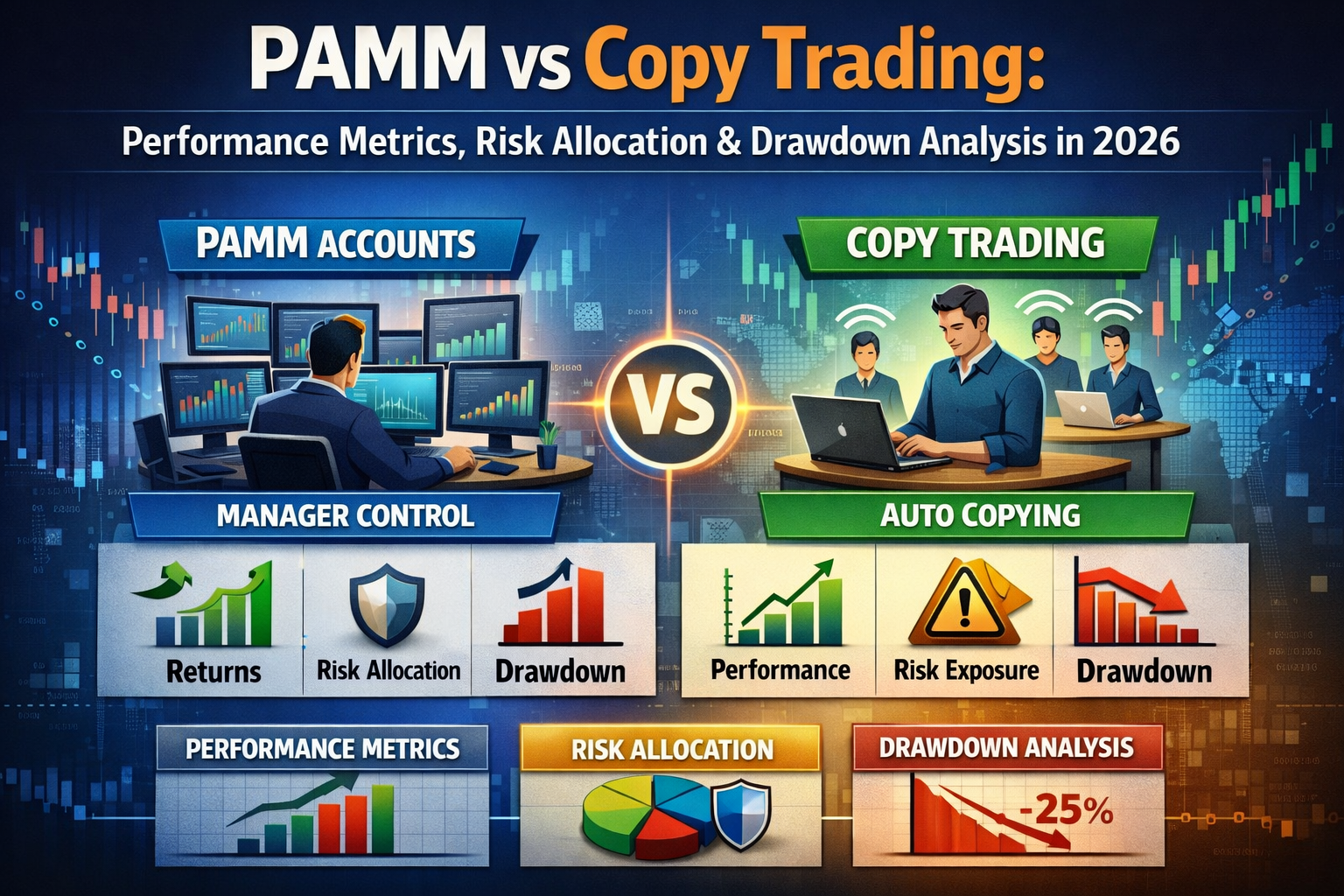
As financial markets evolve, passive and semi-active trading models have become increasingly popular. Some of the most popular strategies are PAMM trading and Copy Trading. Both enable investors to benefit from experienced traders without having to trade on their own. On the face of it, however, they are quite alike; the way they deal with performance, risk, and capital allocation is quite different.
These differences will be critical for anyone wishing to invest capital effectively in 2026. No longer are performance metrics, drawdown control and risk distribution optional considerations; they are the determinants of long-term success in both models.
What Is the Core Difference Between PAMM Trading and Copy Trading?
The primary distinction lies in how capital is handled and implemented. PAMM trading pools investors' capital in a single managed account, with a professional trader managing it on behalf of the participants. Profits and losses are shared equally.
However, with Copy Trading, they can copy another trader's trades directly into their account. Every investor has control over capital and can adjust parameters such as trade size or risk.
Key distinctions include:
• PAMM trading: Centralised management, proportional profit sharing
• Copy Trading: Decentralised trading, risk settings.
• PAMM: Investors are completely dependent on the choices of the manager.
• Copy Trading: Investors can begin or cease copying at any time.
This structural difference affects how performance is measured and how risk is controlled.
How Should Performance Be Evaluated in Both Models?
Performance measurement is more than mere returns. Consistency and risk-adjusted returns in both PAMM trading and copy trading are much more valued than temporary gains.
Performance in PAMM accounts is normally calculated at the account level. Investors consider such measures as:
• Total return over time
• Monthly or quarterly consistency
• Maximum drawdown
• Equity curve stability
In Copy Trading, the performance evaluation is less stringent. As position sizes can vary, the same trader might produce different outcomes across accounts.
Some of the factors of great importance in performance are:
• Win rate vs. risk-reward ratio
• Trade frequency and style
• Consistency across market conditions
In 2026, investors are more focused on a smooth equity curve than on aggressive but volatile returns.
How Does Risk Allocation Differ Between PAMM and Copy Trading?
The difference between the two models is most important in risk allocation.
Risk in PAMM trading is allocated proportionally. Each investor's capital is subject to the same trades at the same relative level. This brings about uniformity but restricts flexibility.
Risk exposure can be tailored by investors in Copy Trading. They may choose to:
• Allocate only a portion of their capital to copying
• Adjust trade size relative to the original trader
• Set personal stop-loss or equity protection limits
Such flexibility enables greater personalisation but entails greater responsibility for the investor.
PAMM trading advantages:
• Simpler structure
• Professional management
• Consistent execution by all investors
Copy Trading advantages:
• Greater control over risk
• Ability to diversify across multiple traders
• Flexibility to adjust exposure in real time
What Role Does Drawdown Analysis Play in Decision-Making?
One of the most significant measures in both models is drawdown. It is the maximum and minimum depreciation in account equity and is the risk assumed to earn returns.
Drawdown in PAMM trading is felt equally by everyone. When there is a 20 per cent drawdown on the account, it affects all the investors equally. This renders drawdown analysis essential prior to investment.
Drawdown in Copy Trading may vary depending on how the investor sets up their account. Nevertheless, the trader's historical drawdown can still be a valuable source of information about risk behaviour.
Some of the important elements of drawdown analysis are:
• Maximum drawdown: The worst historical loss
• Recovery time: How long it takes to regain losses
• Frequency of drawdowns: Whether losses occur often
A plan with high drawdowns is best employed with strong emotional discipline and a longer investment horizon.
In 2026, investors are more interested in the stability of the drawdown than in return percentages, because it directly impacts long-term capital stability.
Which Model Is Better Suited for Modern Investors?
The answer does not exist, and it is best to be relative to the personal goals, experience, and risk tolerance.
PAMM trading tends to be more appropriate for investors who:
• Prefer a hands-off approach
• Trust professional management
• Do not want to actively monitor trades
Copy Trading is more appropriate for people who:
• Want control over their capital
• Prefer flexibility in risk allocation
• Are willing to monitor and adjust settings
There are even investors who utilise both methods. The trick here is to ensure that the model is aligned with personal goals rather than short-term performance.
Conclusion
The PAMM trading and Copy Trading enable investors to engage in financial markets without trading. Success is determined by how they are managed in terms of performance, risk, and drawdown.
PAMM accounts are simple for passive investors, whereas Copy Trading provides flexibility in risk management. Both approaches require measuring performance.
In 2026, focusing on risk management is crucial, with an emphasis on performance stability. Select the best approach according to your financial objectives and risk tolerance.

 English
 Français
 Español
 Português
 Deutsch
 Türkçe
 Dutch
Dutch
 Italiano
 Russian
 Romaian