


How to Defend Against Multi-Extortion Attacks
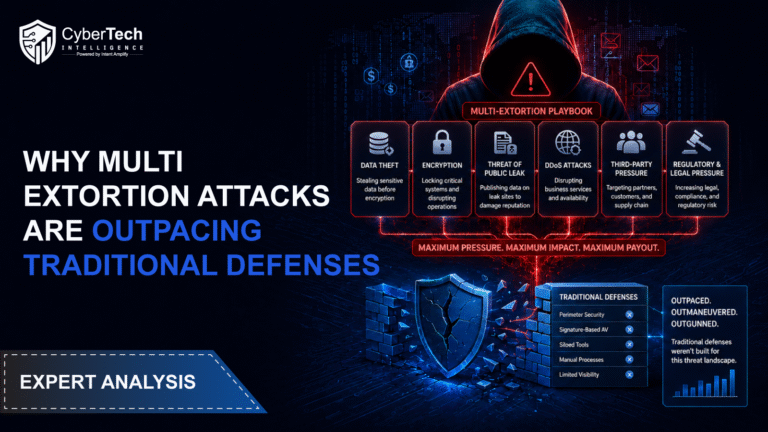
The ransomware threat landscape has undergone a dramatic transformation. What once involved simple file encryption has evolved into highly coordinated campaigns designed to maximize financial pressure from multiple angles. This evolution has given rise to multi-extortion attacks - one of the fastest-growing and most damaging cyber threats facing organizations today.
Unlike traditional ransomware, multi-extortion attacks leverage multiple forms of coercion simultaneously. Attackers no longer rely solely on encrypted data to force payment. Instead, they combine data theft, public exposure threats, operational disruption, regulatory pressure, and even direct communication with customers or partners.
As these tactics become increasingly sophisticated, organizations must rethink how they approach cyber defense.
Understanding Multi-Extortion Tactics
Multi-extortion attacks involve several layers of pressure designed to increase the likelihood of ransom payment.
A typical attack may include:
-
Data encryption
-
Sensitive data exfiltration
-
Threats of public disclosure
-
Distributed denial-of-service (DDoS) attacks
-
Direct targeting of customers, suppliers, or stakeholders
This approach gives threat actors multiple leverage points, even if victims have strong backup and recovery capabilities.
In essence, restoring encrypted files is no longer enough to resolve the crisis.
Why Traditional Defenses Are Falling Short
Many organizations built their ransomware preparedness strategies around backup recovery.
While backups remain critical, they address only one aspect of a modern extortion campaign.
Attackers understand that businesses increasingly maintain resilient recovery systems. As a result, cybercriminals shifted focus toward stolen data and reputational damage.
Common gaps include:
-
Insufficient data visibility
-
Weak third-party security controls
-
Poor access governance
-
Delayed incident detection
-
Inadequate data classification
Without addressing these vulnerabilities, organizations remain exposed even when recovery systems are functioning properly.
The Anatomy of a Multi-Extortion Attack
Modern attacks generally unfold in several stages.
Initial Compromise
Threat actors gain access through:
-
Phishing emails
-
Stolen credentials
-
Vulnerable applications
-
Remote access exploitation
Once inside, they quietly establish persistence.
Internal Reconnaissance
Attackers spend time understanding the environment.
Their objectives include:
-
Locating sensitive information
-
Identifying backup systems
-
Mapping privileged accounts
-
Discovering business-critical applications
This phase often goes undetected for weeks.
Data Exfiltration
Before deploying ransomware, attackers steal large volumes of information.
Targets commonly include:
-
Customer records
-
Financial data
-
Intellectual property
-
Employee information
-
Legal documents
This stolen data becomes a powerful extortion tool.
Extortion Execution
Attackers then initiate multiple pressure tactics simultaneously.
Victims may receive threatening demands:
-
Public leaks
-
Regulatory reporting
-
Customer notifications
-
Business disruption
The goal is psychological and operational pressure rather than technical disruption alone.
Building an Effective Defense Strategy
Organizations must adopt a broader security framework capable of addressing both prevention and response.
Prioritize Data-Centric Security
Understanding where sensitive data resides is essential.
Security leaders should implement:
-
Data discovery programs
-
Classification policies
-
Encryption standards
-
Access controls
Protecting critical information reduces the impact of data theft.
Reduce Lateral Movement Opportunities
Once attackers gain entry, they often move freely across environments.
To limit movement:
-
Segment networks strategically
-
Apply least-privilege principles
-
Restrict administrative access
-
Monitor east-west traffic
Containment is often the difference between a minor incident and a major breach.
Strengthen Detection Capabilities
Early detection remains one of the most effective defenses.
Organizations should deploy:
-
Security information and event management (SIEM)
-
Threat intelligence platforms
-
Endpoint detection tools
-
User behavior analytics
Defenders have more alternatives the sooner suspect activity is discovered.
Prepare for Data Breach Scenarios
Since data theft is now common, organizations need dedicated response plans.
Effective preparation includes:
-
Legal response procedures
-
Regulatory notification workflows
-
Public relations planning
-
Executive crisis communication protocols
Cyber resilience extends beyond technical recovery.
Addressing Human Risk Factors
Technology alone cannot prevent every attack.
Employees remain a critical defense layer.
Regular training should focus on:
-
Phishing recognition
-
Credential security
-
Social engineering awareness
-
Incident reporting procedures
An informed workforce significantly reduces attacker success rates.
The Strategic Importance of Cyber Resilience
The question is no longer whether organizations will face extortion attempts - it is whether they can continue operating effectively during an incident.
Cyber resilience requires balancing:
-
Prevention
-
Detection
-
Response
-
Recovery
-
Business continuity
Organizations that integrate these capabilities into a unified strategy are far more likely to withstand sophisticated attacks.
Conclusion
Multi-extortion attacks are outpacing traditional defenses because they exploit both technical vulnerabilities and business pressures simultaneously. Encryption is only one component of a much larger extortion model that targets reputation, compliance, customer trust, and operational continuity.
Defending against these threats requires a comprehensive approach centered on data protection, visibility, access control, rapid detection, and resilience planning. Organizations that proactively address these areas will be better prepared to reduce risk, minimize disruption, and maintain trust in an era where cyber extortion continues to evolve.

 English
 Arabic
 Français
 Español
 Português
 Deutsch
 Dutch
Dutch
 Italiano
 Russian
 Romaian