


Vibe Coding vs No-Code: Which Is Better for PMs?
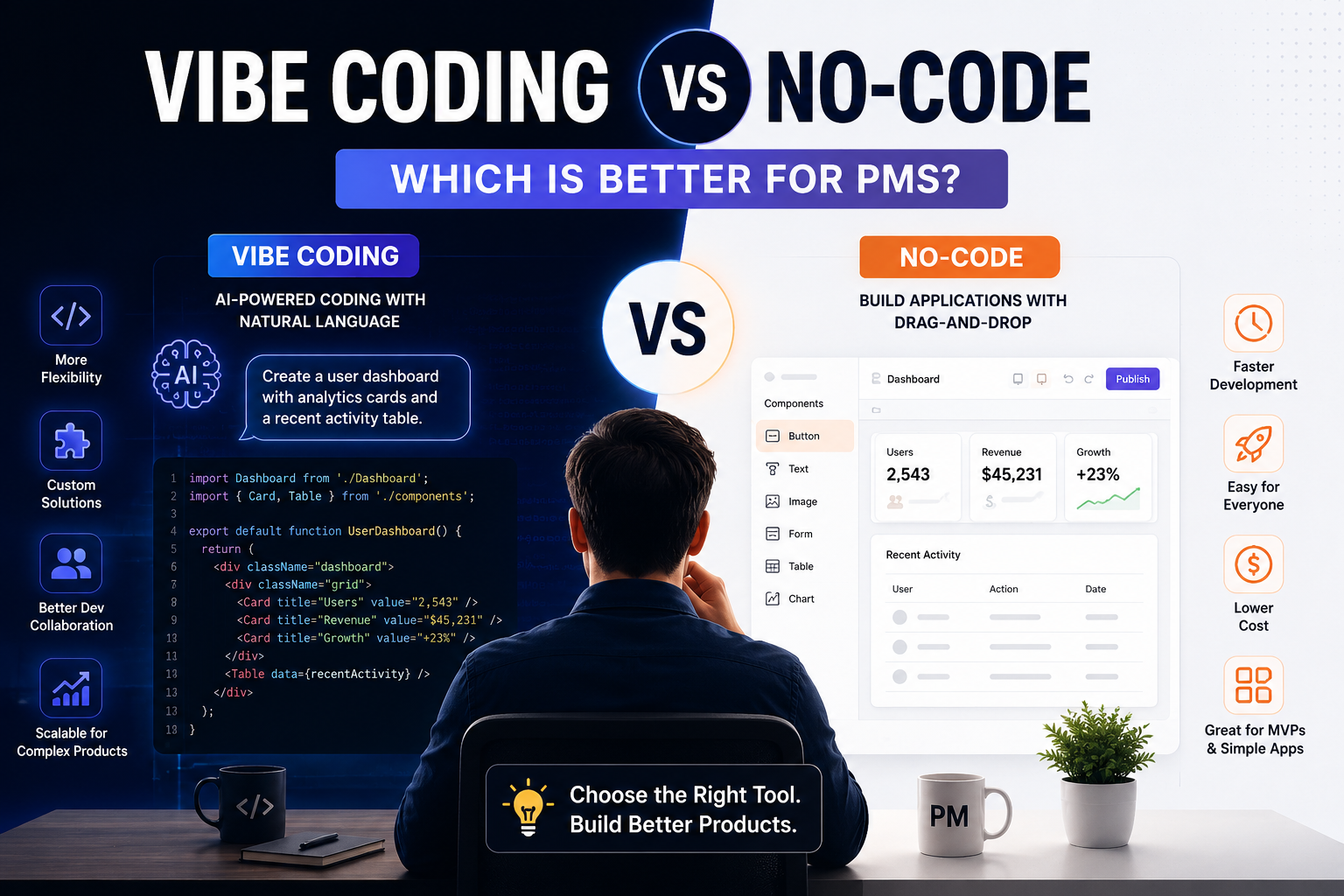
Vibe Coding is generally the better choice for product managers who want to build AI-powered products, collaborate effectively with developers, and future-proof their careers, while no-code is better for quickly creating simple applications without technical complexity. Both approaches have their strengths, but the right option depends on your goals, the products you manage, and how closely you work with engineering teams.
As product management becomes more technical and AI-driven, choosing between vibe coding and no-code has become an important career decision. Although both reduce the need for traditional programming, they serve different purposes. This guide compares Vibe Coding vs No-Code to help you understand which approach offers the greatest value for today's product managers.
Understanding Vibe Coding
Vibe Coding for Product Managers is an AI-assisted way of creating software by describing what you want in natural language. Instead of manually writing every line of code, you prompt AI tools to generate features, fix bugs, explain code, or create working prototypes.
For product managers, vibe coding isn't about becoming a software engineer. It's about using AI to validate ideas faster, communicate technical requirements more clearly, and collaborate more effectively with developers.
Understanding No-Code
No-code platforms allow users to build applications through visual interfaces without writing code.
By dragging and dropping components, configuring workflows, and using templates, PMs can quickly build landing pages, internal tools, dashboards, and MVPs. No-code significantly reduces development time for simple business applications.
Its biggest strength is accessibility—almost anyone can build functional applications without programming experience.
Vibe Coding vs No-Code: Key Differences
| Feature | Vibe Coding | No-Code |
|---|---|---|
| How it works | AI generates code from natural language prompts | Applications are created using visual builders |
| Flexibility | Highly customizable | Limited by platform capabilities |
| Technical Understanding | Basic technical knowledge is helpful | Very little technical knowledge required |
| Best Use Cases | AI-powered products, advanced prototypes, custom features | MVPs, internal tools, websites, workflow automation |
| Developer Collaboration | Excellent | Moderate |
| Scalability | Suitable for complex software | Better for simple to medium-sized applications |
| Learning Curve | Moderate | Easy |
The comparison makes one thing clear: these approaches are not competitors—they're designed for different scenarios.
Why Vibe Coding Is Becoming More Valuable for PMs
Modern product managers work closely with AI-powered products, APIs, automation tools, and software engineering teams. Simply understanding product strategy is no longer enough.
Vibe coding helps PMs participate more actively in the development process by enabling them to:
- Create realistic product prototypes
- Test product ideas before engineering begins
- Understand implementation challenges
- Generate sample code for discussions
- Improve communication with developers
- Experiment with AI-assisted product development
Instead of relying entirely on engineering teams for every technical question, PMs can explore solutions independently and make better-informed decisions.
Where No-Code Still Has the Advantage
No-code platforms remain incredibly useful because they prioritize speed.
If your objective is validating an idea, launching a landing page, building an internal workflow, or creating an MVP within days, no-code is often the better choice.
It is particularly valuable for:
- Startup founders
- Business analysts
- Marketing teams
- Operations managers
- Product managers testing new ideas
For straightforward applications, no-code provides impressive results without requiring any coding knowledge.
Which Option Is Better for Product Managers?
There isn't a universal winner because the right choice depends on your role and goals.
If your daily work involves collaborating with software engineers, discussing APIs, reviewing technical requirements, or building AI-enabled products, vibe coding offers greater long-term value.
On the other hand, if you primarily need to launch simple applications, automate workflows, or validate ideas quickly, no-code platforms may be sufficient.
In many organizations, the most effective PMs understand both approaches and choose the one that fits the project.
Should You Learn Vibe Coding or No-Code First?
If you're completely new to product development tools, learning no-code first can help you understand application design and user workflows.
However, if you're planning a long-term career in product management, learning vibe coding first may be the smarter investment. AI-assisted development is rapidly becoming part of modern software teams, and PMs who understand how to work with AI coding tools are increasingly valuable.
The good news is that these skills complement each other rather than compete.
How to Start Learning Vibe Coding
If you want practical experience with AI-assisted product development, enrolling in a structured vibe coding course can significantly shorten the learning curve.
One option worth considering is the Coursera Vibe coding course designed specifically for product managers. Rather than teaching traditional programming, it focuses on using AI tools to prototype ideas, improve collaboration with developers, and solve real product challenges.
Final Thoughts
The debate over Vibe Coding vs No-Code isn't about replacing one with the other. Each serves a different purpose in modern product development.
No-code platforms excel at helping teams build simple applications quickly with minimal technical knowledge. Vibe coding goes a step further by allowing product managers to leverage AI for software creation, technical collaboration, and rapid experimentation.
As AI continues to reshape software development, Vibe Coding for Product Managers is becoming an increasingly valuable skill. Product managers who understand both vibe coding and no-code will be better equipped to validate ideas faster, communicate effectively with engineering teams, and lead successful products in an AI-driven world.

 English
 Arabic
 Français
 Português
 Deutsch
 Türkçe
 Dutch
Dutch
 Italiano
 Russian
 Romaian