


How Does Kindergarten Support Cognitive Development?
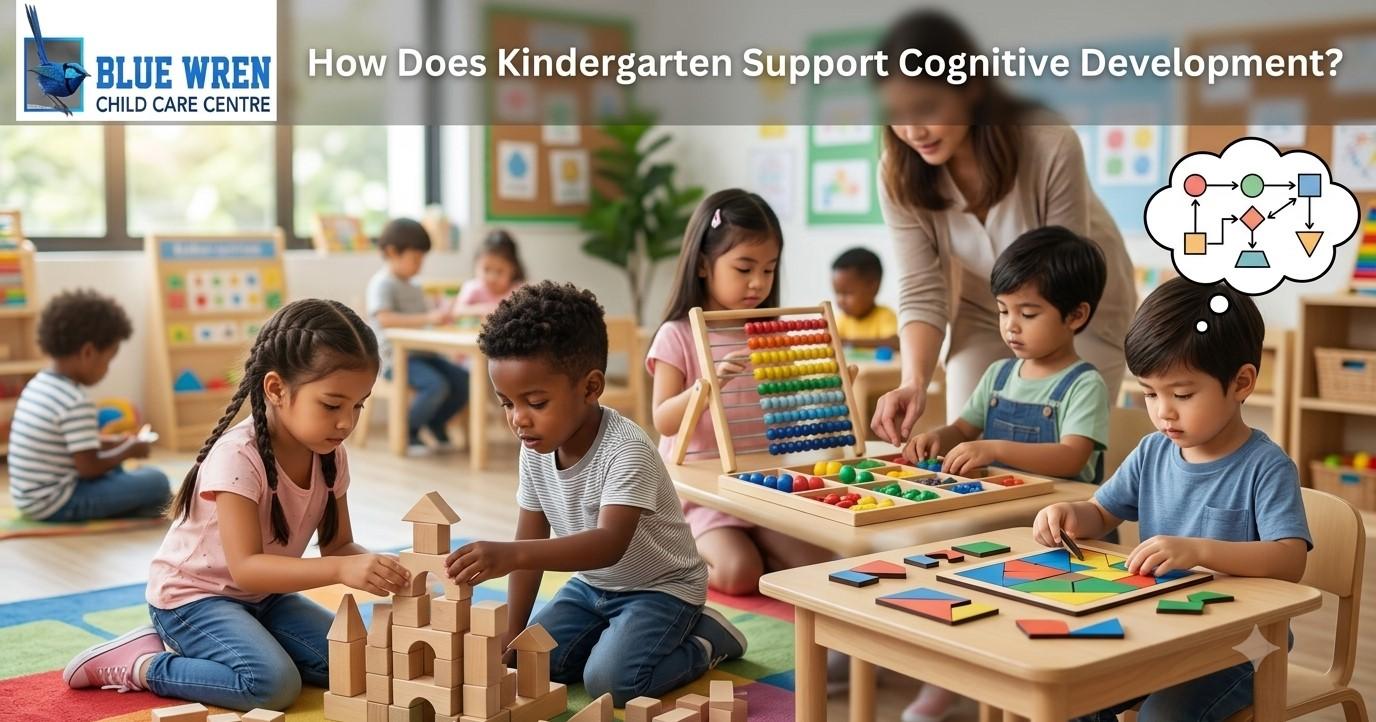
How Does Kindergarten Support Cognitive Development?
Language development acts like a big engine for cognitive growth. In kindergarten there are daily chances for kids to grow their word bank and sharpen how they communicate.
Teachers often prompt kids into talking, story weaving, singing, and sometimes even group discussions. It’s these moments that help children share their ideas in a clearer way and also learn how to “read” other people’s meanings.
Reading times add fresh words and ideas too, so language comprehension gets firmer over time. As children get better at speaking and listening, they start feeling more sure about sharing their thoughts and joining in classroom activities. Strong language skills then flow into literacy, and later on, future academic success.
Strengthening Memory and Attention
These involve strengthening the skills of memory and concentration which help children to learn in all areas. Through repeating and practising instructions, answering questions and performing routines during the day, kindergarten children increase their concentration, memory and attention span.
Children's memory development is also promoted by engaging them in a variety of games, sequencing and puzzles and games and activities involving following patterns and recalling events.
Many early learning centres incorporate a variety of memory games and exercises in children's day programs.
Developing Problem-Solving Skills
Problem Solving: One aspect of the development of a child's brain involves the ability to solve problems. Every day the children face situations, and kindergarten helps them to see these as challenges to overcome. Instead of being offered solutions on a silver platter, the kindergarten teachers encourage the children to think their problems out.
Working on puzzles or building projects may provide opportunities for the children to develop their skills. They then learn that some solutions work and some do not. Children will discover persistence and stick to a problem when faced with obstacles. This will give the children growing confidence in dealing with any challenge they may be faced with in the future.
Learning Through Play
Children learn a lot through play and this one has been designed around this idea of child-led fun that delivers learning benefits.
Children at our play-based learning childcare centre are actively involved in playful explorations – this gives them the opportunity to experiment, create, hypothesise and test new ideas.
Playing with blocks, role-playing, playing with sensory materials, art creation or singing and dancing allows children to expand their capacity for imaginative thinking and critical and creative thought. It gives them practice in hypothesising, planning, making choices, communicating their ideas to others and adapting their behaviour. Playing means children engage in and construct their learning.
Supporting Social Thinking
The learning experiences and social lessons of kindergarten promote more than intellectual growth. Young children, through play and structured group activities, learn how to get along with others.
Through a great deal of interaction with other children in the kindergarten environment, they can practise sharing, listening to each other, cooperating, negotiating and taking on the perspective of another person.
The learning that occurs in collaborative play reinforces cognitive growth as well as emotional growth and develops social intelligence, fostering flexible and creative thinking processes to meet the demands of a group learning task and problem-solving with a varied repertoire of possible solutions.
Encouraging Creativity and Imagination
Creative activities also prompt cognitive development. When they are being creative, they often have to go past simple answers and solutions. Engaging in artistic and dramatic play, music and storytelling is an opportunity for them to present ideas in a different manner. Creative play experiences facilitate connections and development of innovative thinking.
They can look into all of the possibilities, have a go at new things, and then communicate the ideas that they have discovered. Good play-based learning childcare centres usually use creative play experiences as an essential and integral component of each day.
Preparing Children for Future Learning
Kindergarten provides children with a solid foundation to learn for life. Students learn to make ready for kindergarten as well as other learning challenges which will include problem-solving, communicating, focusing, and coping in order to manage and connect with the world.
The optimal kindergarten in Kurmond will present you with an emphasis on academics, as well as a focus on developmental readiness, so the children have confidence along with better problem-solving skills.
Many early learning centres understand every child develops individually and will provide specific care to ensure success.
Conclusion
A vital stage for early cognitive development, play in kindergarten fosters cognitive skills such as exploratory skills, communication, critical thinking skills, creative activities and peer play for the development of children for the future.
A good kindergarten school has a really positive space for child development, where it nurtures curiosity and creativity and helps kids grow into confident and effective learners.
It should be supported by relevant activities that foster cognitive growth in a way that lasts a lifetime, which is a key responsibility for any strong school.

 English
 Français
 Español
 Português
 Deutsch
 Türkçe
 Dutch
Dutch
 Italiano
 Russian
 Romaian