


How does IVF Laboratory Design ensure contamination control and cleanroom compliance?
INTRODUCTION
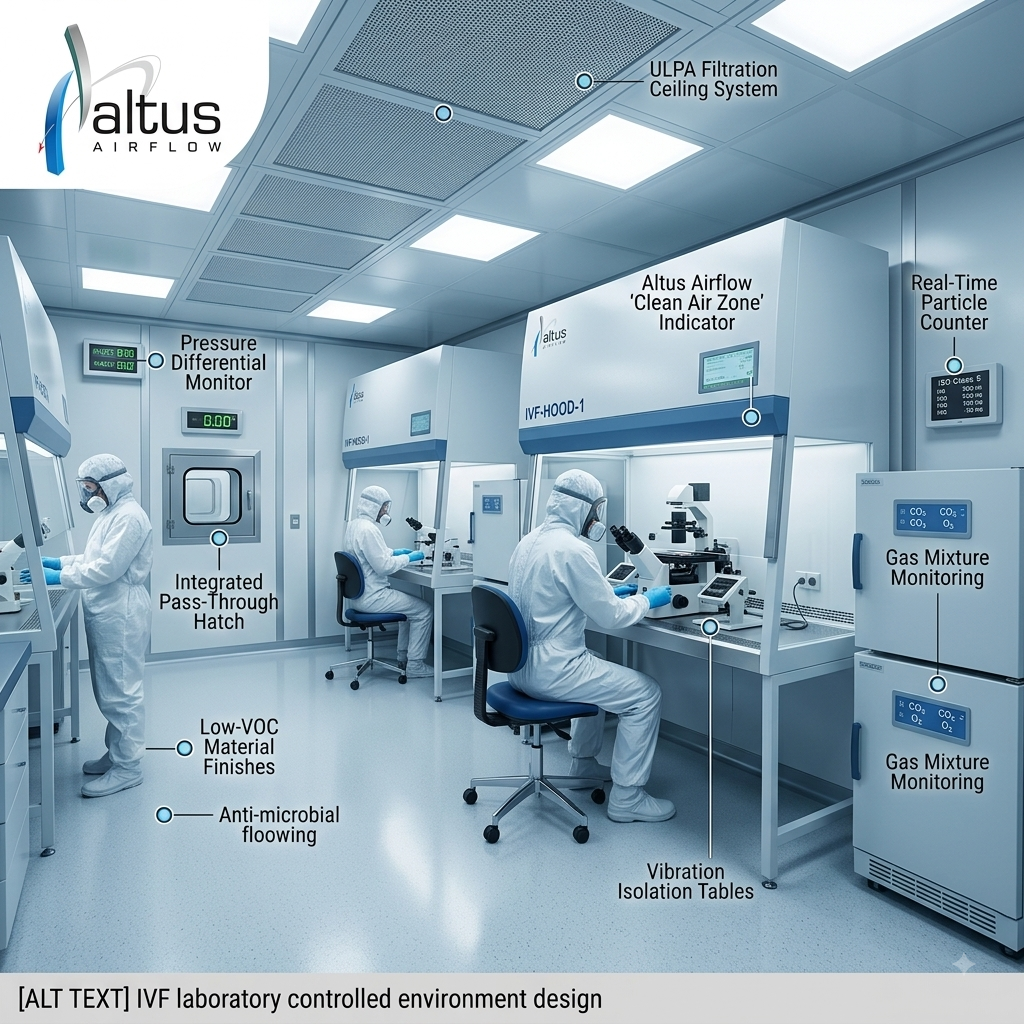
IVF Laboratory Design plays a critical role in controlling contamination and creating a stable, controlled environment for sensitive assisted reproductive procedures. Unlike conventional laboratories, IVF facilities require carefully planned environmental conditions because embryos, gametes, and reproductive materials can be affected by airborne particles, volatile compounds, temperature fluctuations, humidity changes, and other environmental factors. Effective design therefore combines cleanroom principles, HVAC engineering, filtration, zoning, controlled access, suitable materials, monitoring, and validated operating procedures to create a consistent laboratory environment.
Why Contamination Control Matters in IVF Laboratories
IVF laboratories handle highly sensitive biological materials during procedures such as:
- Oocyte handling
- Sperm preparation
- Fertilization
- Embryo culture
- Embryo assessment
- Cryopreservation
- Micromanipulation procedures
These activities require a controlled environment where unnecessary contamination risks are minimized.
Contamination can originate from several sources, including:
- Personnel
- Airborne particles
- Cleaning products
- Building materials
- Equipment
- Dust
- Microorganisms
- Volatile organic compounds
- Improper airflow
- Inadequate cleaning
A well-engineered laboratory reduces opportunities for contaminants to enter or accumulate in critical areas.
1. Proper Laboratory Zoning
Zoning is one of the foundations of contamination control.
An IVF laboratory may be divided into areas according to their function and cleanliness requirements.
Typical spaces can include:
- Embryology laboratory
- Andrology laboratory
- IVF procedure room
- Media preparation area
- Cryopreservation area
- Washing areas
- Storage areas
- Staff changing areas
- Gowning areas
- Support spaces
The exact zoning depends on the facility's workflow and applicable requirements.
Proper zoning helps prevent unnecessary movement between areas with different environmental requirements.
2. Controlled Personnel Movement
Personnel can introduce particles and microorganisms into controlled environments.
Therefore, the laboratory layout should establish a logical movement path.
This can involve:
- Entry into the facility
- Changing area
- Gowning
- Hand hygiene
- Controlled laboratory entry
- Movement between designated laboratory areas
Limiting unnecessary movement can help reduce contamination risks.
3. Gowning and Entry Controls
Appropriate gowning procedures can reduce the introduction of particles from personnel.
Depending on the facility's procedures, controlled areas may require:
- Laboratory coats or gowns
- Hair covers
- Shoe covers
- Masks
- Gloves
- Dedicated footwear
The design should provide sufficient space for personnel to change and prepare before entering controlled laboratory areas.
4. HVAC System Design
HVAC is one of the most important engineering systems in an IVF laboratory.
A properly designed HVAC system can help control:
- Temperature
- Relative humidity
- Air changes
- Air filtration
- Air movement
- Pressure relationships
- Fresh-air supply
The system should be designed around the laboratory's operational requirements rather than simply adapting a standard commercial HVAC system.
5. HEPA Filtration
High-efficiency particulate filtration can help reduce airborne particulate contamination.
HEPA filters can be integrated into the air supply system for designated controlled areas.
The design should consider:
- Filter efficiency
- Airflow volume
- Filter loading
- Pressure drop
- Filter housing
- Sealing
- Accessibility
- Testing requirements
Filter integrity and system performance should be verified through appropriate testing procedures.
6. Airflow Management
Airflow direction and distribution can influence contamination control.
Poorly designed airflow can cause unwanted air mixing or transfer contaminants between spaces.
An engineered system can establish appropriate airflow patterns between:
- Clean areas
- Less-controlled areas
- Support areas
- Corridors
The objective is to manage air movement so that it supports the laboratory's zoning and contamination-control strategy.
7. Pressure Relationships
Pressure differentials can help control the movement of air between rooms.
Depending on the laboratory design, pressure relationships may be established between:
- Embryology laboratory
- Preparation areas
- Corridors
- Gowning areas
- Support rooms
Pressure monitoring systems can help detect changes that could affect the intended airflow direction.
8. Temperature Control
Embryology laboratories require stable environmental conditions.
Temperature fluctuations can affect laboratory operations and equipment performance.
A properly engineered HVAC system can provide controlled temperature conditions through:
- Precision cooling
- Temperature sensors
- Automated controls
- Air handling systems
- Monitoring systems
Stable environmental conditions contribute to consistent laboratory operation.
9. Humidity Management
Relative humidity also needs to be considered.
Excessive or insufficient humidity can affect:
- Personnel comfort
- Equipment operation
- Material performance
- Environmental stability
Humidity sensors and HVAC controls can help maintain the specified range.
The actual set points should be established according to laboratory requirements and applicable guidance.
10. Volatile Organic Compound Control
IVF laboratories require particular attention to chemical emissions because some volatile compounds can be undesirable in sensitive reproductive laboratory environments.
Potential sources include:
- Adhesives
- Paints
- Sealants
- Cleaning chemicals
- Furniture
- Building materials
- Plastics
Material selection should therefore consider low-emission options where appropriate.
The laboratory should also use appropriate ventilation and chemical-control procedures.
11. Selection of Low-Emission Materials
Materials used in laboratory construction can influence indoor air quality.
Suitable materials should be:
- Low-emission
- Durable
- Easy to clean
- Resistant to cleaning agents
- Non-shedding
- Smooth
- Suitable for controlled environments
Special attention should be given to paints, sealants, flooring, adhesives, ceiling systems, and furniture.
12. Hygienic Wall and Ceiling Systems
Laboratory walls and ceilings should be designed to minimize areas where dust or contaminants can accumulate.
Preferred features can include:
- Smooth surfaces
- Sealed joints
- Minimal ledges
- Cleanable finishes
- Properly sealed service penetrations
- Durable construction
This supports regular cleaning and reduces potential contamination reservoirs.
13. Appropriate Flooring
Flooring should be selected based on laboratory requirements.
It should ideally provide:
- Smooth surfaces
- Easy cleaning
- Resistance to chemicals
- Minimal joints
- Durable performance
- Compatibility with disinfectants
Damaged or deteriorated flooring can create areas that are difficult to clean effectively.
14. Cleanroom-Compatible Furniture
Furniture should be selected with contamination control in mind.
Laboratory furniture should minimize:
- Dust traps
- Difficult-to-clean surfaces
- Unnecessary gaps
- Particle-shedding materials
Workstations should also support efficient laboratory workflow without creating unnecessary personnel movement.
15. Controlled Laboratory Workflow
Workflow planning is critical to contamination prevention.
A good laboratory layout separates activities according to their cleanliness and operational requirements.
For example, the movement of:
- Personnel
- Samples
- Media
- Equipment
- Waste
should be considered during design.
The objective is to avoid unnecessary crossing of clean and less-controlled workflows.
16. Equipment Placement
Equipment can influence both workflow and airflow.
An IVF laboratory may contain:
- Incubators
- Microscopes
- Micromanipulation systems
- Cryogenic storage equipment
- Workstations
- Centrifuges
- Biological safety equipment where required
- Specialized laboratory instruments
Equipment should be positioned to allow safe operation, maintenance access, and appropriate airflow.
17. Incubator Environment Protection
Incubators provide controlled microenvironments for embryo culture.
The surrounding laboratory environment can influence the stability and reliability of incubator operation.
Therefore, the laboratory design should support:
- Stable room temperature
- Appropriate humidity
- Clean supply air
- Reliable power
- Controlled access
- Equipment maintenance
Backup power may also be considered where appropriate.
18. Monitoring and Alarm Systems
Environmental monitoring provides visibility into laboratory conditions.
Systems may monitor:
- Temperature
- Humidity
- Differential pressure
- Airflow
- Filter pressure
- Equipment alarms
Alarm systems can notify staff when selected parameters move outside defined limits.
This allows corrective action to be taken before environmental deviations become significant operational problems.
19. Environmental Testing
Commissioning and validation are important after construction.
Testing may include:
- Airflow measurements
- HEPA filter integrity testing
- Particle counting
- Pressure differential testing
- Temperature mapping
- Humidity verification
- Air change verification
- Recovery testing where applicable
Testing requirements should be established according to the laboratory's design and applicable standards.
20. Particle Monitoring
Particle monitoring can provide information about the cleanliness of controlled areas.
Monitoring programs may evaluate airborne particle concentrations according to the relevant cleanroom classification or facility requirements.
Measurements can help identify:
- Unexpected contamination
- HVAC problems
- Filter issues
- Personnel-related particle increases
- Cleaning deficiencies
Monitoring frequency should be determined by the facility's quality system.
21. Microbiological Monitoring
Where required by the laboratory's quality program, microbiological monitoring can complement physical environmental monitoring.
Monitoring may evaluate:
- Airborne microorganisms
- Surface contamination
- Personnel-related contamination
Results can help identify trends and support corrective actions.
22. Cleaning and Disinfection
Regular cleaning is essential for contamination control.
The laboratory should have documented procedures covering:
- Cleaning frequency
- Approved disinfectants
- Surface compatibility
- Cleaning sequence
- Personnel responsibilities
- Spill response
- Documentation
Cleaning products should be selected carefully to avoid introducing undesirable chemical contamination.
23. Preventive Maintenance
Environmental systems must remain properly maintained after commissioning.
Preventive maintenance may include:
- HEPA filter inspection
- HVAC servicing
- Sensor calibration
- Fan maintenance
- Airflow verification
- Pressure sensor checks
- Alarm testing
- Cleaning of accessible components
Maintenance records should be retained as part of the laboratory's quality documentation.
24. Cleanroom Compliance and Standards
Cleanroom compliance is not achieved simply by installing HEPA filters.
The laboratory must be considered as a complete system involving:
- Room classification
- Airflow
- Filtration
- Pressure
- Materials
- Personnel practices
- Cleaning
- Monitoring
- Testing
- Documentation
Depending on the project, designers may refer to applicable cleanroom standards such as ISO 14644 series requirements, healthcare engineering guidance, national regulations, and laboratory-specific quality requirements.
The exact standards applicable to an IVF facility should be confirmed for the project's location, scope, and intended operation.
25. Documentation and Validation
A compliant laboratory should have appropriate documentation.
This can include:
- Design drawings
- HVAC calculations
- Equipment specifications
- Material specifications
- Testing reports
- Calibration records
- Cleaning procedures
- Maintenance schedules
- Environmental monitoring records
- Validation documentation
Proper documentation provides traceability and helps demonstrate that the facility continues to operate according to its defined requirements.
26. Staff Training
Even the most advanced laboratory cannot maintain contamination control without trained personnel.
Staff should understand:
- Gowning procedures
- Cleaning requirements
- Laboratory access rules
- Equipment handling
- Material transfer
- Waste handling
- Environmental alarms
- Contamination-response procedures
Training should be documented and periodically reviewed.
27. Preventing Cross-Contamination
Cross-contamination can occur when materials, personnel, equipment, or airflow move between incompatible areas.
Design strategies can include:
- Controlled access
- Logical zoning
- Dedicated workflows
- Appropriate pressure relationships
- Separate material pathways
- Effective cleaning procedures
The goal is to minimize unnecessary contact between different operational areas.
28. Quality Management Integration
Cleanroom compliance should form part of the laboratory's broader quality management system.
The facility should establish procedures for:
- Environmental monitoring
- Equipment maintenance
- Cleaning
- Calibration
- Validation
- Deviation management
- Corrective actions
- Record keeping
This creates a systematic approach to maintaining laboratory performance.
29. Why Professional Design Matters
IVF laboratory environments are more demanding than ordinary laboratory spaces because biological materials are sensitive to environmental conditions.
Professional design considers multiple systems simultaneously:
- Architecture
- HVAC
- Filtration
- Airflow
- Electrical infrastructure
- Equipment
- Workflow
- Monitoring
- Maintenance
This integrated approach can reduce design conflicts and support more reliable laboratory operation.
30. Long-Term Contamination Control
Contamination control does not end when laboratory construction is completed.
Continuous performance requires:
- Regular monitoring
- Preventive maintenance
- Environmental testing
- Cleaning
- Staff training
- Equipment calibration
- Filter management
- Periodic review
A laboratory should be treated as a continuously managed controlled environment rather than a one-time construction project.
Conclusion
Effective IVF Laboratory Design combines cleanroom principles, HVAC engineering, HEPA filtration, controlled zoning, pressure management, low-emission materials, hygienic construction, environmental monitoring, validation, cleaning, and preventive maintenance to reduce contamination risks and support a stable laboratory environment. Compliance depends on the complete facility rather than one individual component, and applicable standards should be identified according to the project's location and operational requirements. Altus Airflow provides engineered laboratory and controlled-environment solutions focused on HVAC integration, airflow management, filtration, modular construction, monitoring, testing, and long-term facility performance.
Frequently Asked Questions
1. How does IVF Laboratory Design control contamination?
IVF Laboratory Design controls contamination through zoning, controlled access, HEPA filtration, HVAC management, appropriate airflow, pressure control, hygienic materials, cleaning procedures, environmental monitoring, and preventive maintenance.
2. Why is HVAC important in IVF Laboratory Design?
HVAC helps control temperature, humidity, filtration, air changes, and airflow direction. Properly engineered IVF Laboratory Design integrates HVAC with laboratory zoning and contamination-control requirements.
3. Does IVF Laboratory Design require HEPA filtration?
HEPA filtration is commonly incorporated into controlled laboratory environments where high levels of airborne particulate control are required. The specific filtration strategy should be determined through project requirements and applicable standards.
4. What cleanroom standards can apply to IVF laboratories?
IVF Laboratory Design may consider applicable requirements from cleanroom standards such as the ISO 14644 series, along with healthcare, national, laboratory, and quality-system requirements relevant to the project.
5. How does zoning help contamination control?
Zoning separates areas according to their functions and environmental requirements. Proper IVF Laboratory Design can establish controlled movement between laboratories, preparation areas, corridors, gowning spaces, and support areas.
Read Our Previous Blog------>What are the benefits of choosing a professional Modular Ophthalmic OT Manufacturers?

 Arabic
 Français
 Español
 Português
 Deutsch
 Türkçe
 Dutch
Dutch
 Italiano
 Russian
 Romaian