Leadvent Group is one of the world's leading business to business event management company based in Europe, specializing in organizing small-scale business meetings, strategic focused conferences and forums on a global level. We empower progressive and forward-thinking companies with the best practices for today’s fast-changing market by providing conference that encourage interactive discussion, knowledge sharing, strategic benchmarking and networking.
Social Links
Search
Recent Updates
  • What Makes Windpower Data the Driving Force Behind Next-Generation Energy Growth
    Nations around the world are actively shifting away from fossil fuels toward cleaner alternatives. Wind power has become one of the most reliable and scalable sources of renewable energy across the globe. But what truly powers the growth of wind energy is not just the wind itself. It is the smart collection and use of data. The way nations, businesses, and local communities approach long-term...
    0 Comments 0 Shares 37 Views 0 Reviews
  • The Bioplastics Boom: Why Circular Packaging Is Becoming Big Business
    The packaging industry is going through one of the biggest shifts in its history. Companies, governments, and consumers are all asking the same question: how do we move away from plastic waste and toward materials that actually support a healthier planet? This is where biopolymers, bioplastics, and circular packaging come in. Events like the Circular Packaging Summit bring together global...
    0 Comments 0 Shares 94 Views 0 Reviews
  • Future-Proofing Global Connectivity: Innovations in Subsea Cable Installation and Reliability
    In today’s digital world, global connectivity is no longer a luxury—it is a necessity. From video calls to cloud computing, nearly every online activity depends on a hidden network beneath the oceans. These underwater systems carry the majority of international data traffic, making them one of the most important parts of modern infrastructure. As demand for faster and more reliable...
    0 Comments 0 Shares 218 Views 0 Reviews
  • The 4th Annual EV Charging Infrastructure Forum is a focused industry gathering that brings together policymakers, utilities, city planners, charging solution providers, and fleet operators to discuss the real-world expansion of electric mobility. The event centers on practical approaches to building reliable EV Charging Infrastructure, addressing planning gaps, grid capacity, and long-term network performance.

    Through expert panels and peer discussions, the forum examines current challenges in EV Charging Installation, including site readiness, permitting, and cost control. As one of the leading EV Charging events in Europe, the forum offers a platform for knowledge exchange, policy insight, and collaboration across the charging ecosystem.
    #event#europe#socialmedia#evcharging
    The 4th Annual EV Charging Infrastructure Forum is a focused industry gathering that brings together policymakers, utilities, city planners, charging solution providers, and fleet operators to discuss the real-world expansion of electric mobility. The event centers on practical approaches to building reliable EV Charging Infrastructure, addressing planning gaps, grid capacity, and long-term network performance. Through expert panels and peer discussions, the forum examines current challenges in EV Charging Installation, including site readiness, permitting, and cost control. As one of the leading EV Charging events in Europe, the forum offers a platform for knowledge exchange, policy insight, and collaboration across the charging ecosystem. #event#europe#socialmedia#evcharging
    0 Comments 0 Shares 2K Views 0 Reviews
  • 3
    Feb
    Amsterdam, Netherlands
    The 3rd Annual Wind Blade Materials and Recycling Forum is a focused international industry forum dedicated to advancing sustainable solutions for wind turbine blade materials and end-of-life management. The event brings together experts from across the wind energy ecosystem to address the technical, environmental, and commercial challenges associated with blade recycling and circularity.
    0 Comments 0 Shares 634 Views 0 Reviews
  • This event brings together industry experts, innovators, and sustainability leaders to explore the complete lifecycle of wind turbine blades—from advanced manufacturing to responsible end-of-life recycling. As wind energy capacity grows globally, managing retired wind blades has become a critical environmental challenge. The event focuses on emerging recycling technologies, circular economy strategies, regulatory developments, and real-world solutions that support sustainable wind energy growth. Designed for professionals across renewable energy, recycling, materials science, and policy, the event aims to drive meaningful conversations and actionable insights for a greener energy future.
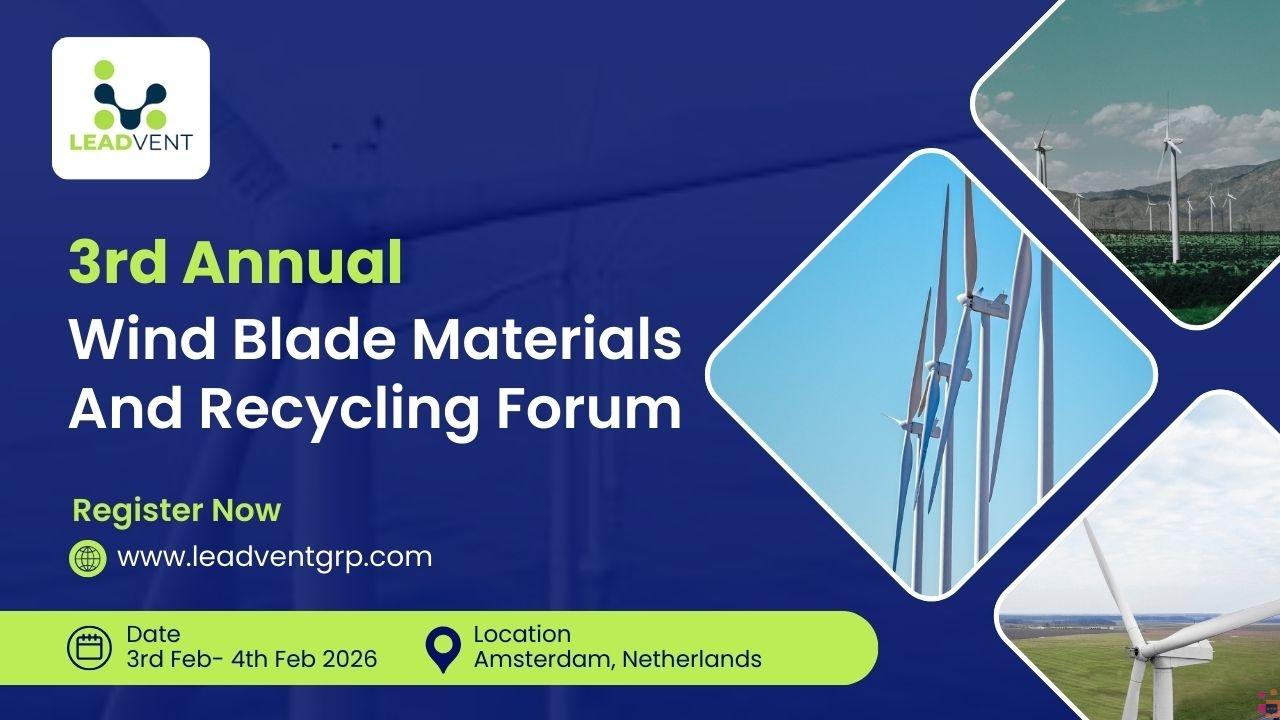
    This event brings together industry experts, innovators, and sustainability leaders to explore the complete lifecycle of wind turbine blades—from advanced manufacturing to responsible end-of-life recycling. As wind energy capacity grows globally, managing retired wind blades has become a critical environmental challenge. The event focuses on emerging recycling technologies, circular economy strategies, regulatory developments, and real-world solutions that support sustainable wind energy growth. Designed for professionals across renewable energy, recycling, materials science, and policy, the event aims to drive meaningful conversations and actionable insights for a greener energy future.
    0 Comments 0 Shares 1K Views 0 Reviews
  • https://www.leadventgrp.com/blog/the-lifecycle-of-a-wind-blade-from-manufacturing-to-recycling
    The blog outlines the full life cycle of modern wind turbine blades, from how they are made to what happens at the end of their service life. It explains that blades are manufactured using complex composite materials (mainly glass-fiber reinforced polymers with thermoset resins), which makes them strong but difficult to recycle. During their 20–30 year operational life, blades endure harsh environmental conditions. When turbines are retired, the blades pose a growing waste challenge due to their size and tough chemical bonds—leading many to previously end up in landfills. Because of stricter regulations (e.g., upcoming landfill bans in Europe), the industry is exploring advanced recycling methods like mechanical recycling, pyrolysis, and chemical processes such as solvolysis, as well as creative reuse in construction or art. New materials (like thermoplastics) are also being developed to make future blades easier to recycle. The article highlights the urgency for scalable, sustainable recycling solutions as the volume of retired blades increases and points to industry efforts and forums addressing these challenges.
    https://www.leadventgrp.com/blog/the-lifecycle-of-a-wind-blade-from-manufacturing-to-recycling The blog outlines the full life cycle of modern wind turbine blades, from how they are made to what happens at the end of their service life. It explains that blades are manufactured using complex composite materials (mainly glass-fiber reinforced polymers with thermoset resins), which makes them strong but difficult to recycle. During their 20–30 year operational life, blades endure harsh environmental conditions. When turbines are retired, the blades pose a growing waste challenge due to their size and tough chemical bonds—leading many to previously end up in landfills. Because of stricter regulations (e.g., upcoming landfill bans in Europe), the industry is exploring advanced recycling methods like mechanical recycling, pyrolysis, and chemical processes such as solvolysis, as well as creative reuse in construction or art. New materials (like thermoplastics) are also being developed to make future blades easier to recycle. The article highlights the urgency for scalable, sustainable recycling solutions as the volume of retired blades increases and points to industry efforts and forums addressing these challenges.
    0 Comments 0 Shares 2K Views 0 Reviews
  • What is Renewable Energy?
    In a world moving toward sustainability, renewable energy is at the forefront of the clean energy revolution. Unlike fossil fuels, which are finite and polluting, renewable energy sources are naturally replenished and significantly reduce carbon emissions. With governments, businesses, and individuals embracing green energy, the demand for sustainable power is skyrocketing. Events like the...
    0 Comments 0 Shares 684 Views 0 Reviews
  • What Are Low-Carbon Fuels?
    With climate change becoming an urgent global issue, the need for low-carbon fuels is greater than ever. These fuels offer a cleaner alternative to traditional fossil fuels by reducing greenhouse gas emissions and supporting a sustainable energy future. From biofuels to hydrogen and synthetic fuels, low-carbon energy sources are transforming transportation, industry, and power generation. The...
    0 Comments 0 Shares 618 Views 0 Reviews
  • How Floating Solar Panels are Shaping the Future of Energy Storage?
    The transition to renewable energy is accelerating, and floating solar panels are emerging as a game-changer. With land scarcity and energy demand on the rise, installing solar panels on water bodies is proving to be an innovative solution. These floating power systems not only generate clean electricity but also enhance energy storage capabilities for a more sustainable grid. The upcoming...
    0 Comments 0 Shares 641 Views 0 Reviews
  • The Role of International Collaboration in Submarine Cable Damage Management
    Submarine cables are the backbone of global communications, carrying over 99% of international data traffic. Despite their critical role, these cables are vulnerable to natural disasters, human activities, and geopolitical tensions. Submarine cable damage and repair require swift action and seamless coordination among nations, telecom operators, and maritime agencies. International...
    0 Comments 0 Shares 592 Views 0 Reviews
  • Why Sustainable Investing is the Future of Finance?
    The financial world is undergoing a massive transformation. Traditional investment strategies are no longer enough—investors are now prioritizing sustainable investing to drive long-term growth and impact. This shift is driven by climate concerns, regulatory changes, and consumer demand for ethical business practices. At the forefront of this movement is the Climate Innovation Conference,...
    0 Comments 0 Shares 364 Views 0 Reviews
More Stories