


AI-Powered EOR: How Real-Time Compliance Monitoring Reduces Risk

For most of the EOR industry’s existence, compliance has been a periodic event. Quarterly reviews. Annual audits. Contract updates triggered by a memo from legal. Between those checkpoints, the assumption was that nothing had changed.
That assumption stopped being safe around 2024. By 2026, it will be actively dangerous.
Labor laws now change at a pace that manual processes cannot match. The EU Pay Transparency Directive’s transposition deadline is June 7, 2026. The Netherlands expects its Wet VBAR contractor classification law to take effect on July 1, 2026. The UK’s Statutory Sick Pay reforms took effect on April 6, 2026. India’s EPFO amnesty window closed on April 30, 2026. Germany’s minimum wage and mini-job thresholds changed on January 1, 2026. Chile’s workweek reduction hit its latest milestone on April 26, 2026.
Each of these changes affects payroll calculations, contract terms, or benefits entitlements. Missing even one means your employees are either underpaid or your company is non-compliant. Often both.
This is why AI-integrated compliance monitoring has become the defining differentiator in EOR services for 2026.
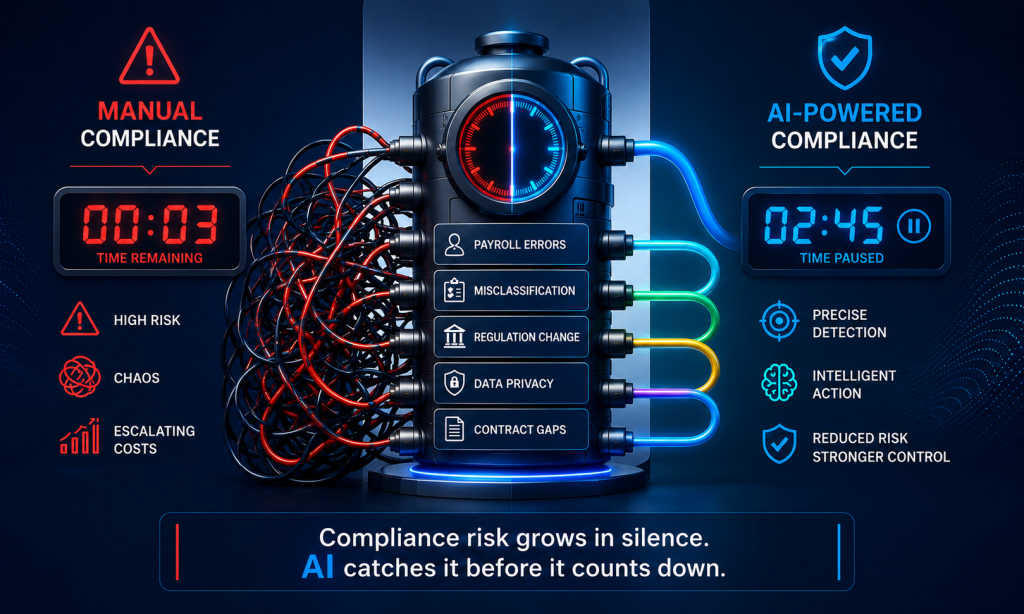
What AI Actually Does in an EOR Compliance Stack
Strip away the marketing language, and the functional value of AI in EOR compliance comes down to three capabilities.
Regulatory change detection. AI systems scan regulatory databases, government gazettes, and legal publications across jurisdictions in real time. When a law changes, the system identifies which employment contracts, payroll configurations, or benefits structures are affected and flags them for action. This replaces the old model where a local legal team might notice a change weeks after it took effect.
Anomaly detection in payroll and classification. Machine learning models trained on payroll data can identify patterns that indicate misclassification risk, payment errors, or statutory contribution gaps before they become audit findings. A contractor who has been invoicing the same amount on the same schedule for 18 months looks like an employee to an algorithm for the same reason it looks like an employee to a tax auditor.
Predictive risk scoring. By analyzing regulatory trends, enforcement patterns, and the company’s own workforce data, AI can assign risk scores to specific jurisdictions, employment arrangements, or contract structures. This allows compliance teams to prioritize where to focus limited resources instead of treating every country as equally urgent.
Where AI Falls Short (and Why Human Expertise Still Matters)
AI is not a replacement for local legal expertise. It is an accelerant for it.
Labor law is not a dataset with clean answers. It is a system of interpretations, precedents, and administrative practices that vary by jurisdiction and sometimes by individual enforcement officer. AI can detect that a law has changed. It cannot reliably predict how a local labor court will interpret that change in a specific dispute.
The most effective AI-powered EOR platforms combine automated detection and flagging with in-country legal teams who apply local judgment. The AI handles the volume problem: scanning hundreds of regulatory sources and thousands of employment contracts simultaneously. The human handles the interpretation problem: deciding what the change means for a specific client’s workforce structure.
When evaluating EOR providers that claim AI capabilities, ask what the AI actually does versus what the marketing suggests. Can they show you the regulatory change log? Can they demonstrate how an alert moved from detection to contract amendment? If the answer is vague, the AI is likely cosmetic.
The Business Case Is Not About Technology
CFOs do not care about AI for its own sake. They care about three things: reducing the cost of compliance failures, shortening the time between regulatory change and operational adjustment, and getting audit-ready documentation without a fire drill every quarter.
Real-time compliance monitoring addresses all three. A regulatory change that is detected and acted on within 72 hours instead of 90 days eliminates the window during which the company is unknowingly non-compliant. That window is where fines, back-pay claims, and reputational damage accumulate.
Global spending on AI governance and compliance is projected to reach $2.54 billion in 2026. That number reflects a market-wide recognition that periodic, manual compliance is no longer viable at the pace at which regulations are changing.
What to Do Next
If your EOR provider’s compliance process still depends on quarterly legal reviews and manual contract updates, the question is not whether you will miss a regulatory change. It is how many you have already missed. Compunnel’s AI-integrated EOR platform combines real-time regulatory monitoring with in-country legal teams across 150+ countries. See what continuous compliance looks like.
This blog was originally published on Compunnel's official website.
The blog was originally published at Compunnel: https://www.compunnel.com/blogs/ai-powered-eor-how-real-time-compliance-monitoring-reduces-risk/

 English
 Arabic
 Français
 Español
 Português
 Deutsch
 Dutch
Dutch
 Italiano
 Russian
 Romaian