


How to Conduct an AI Risk Assessment Using ISO 42001
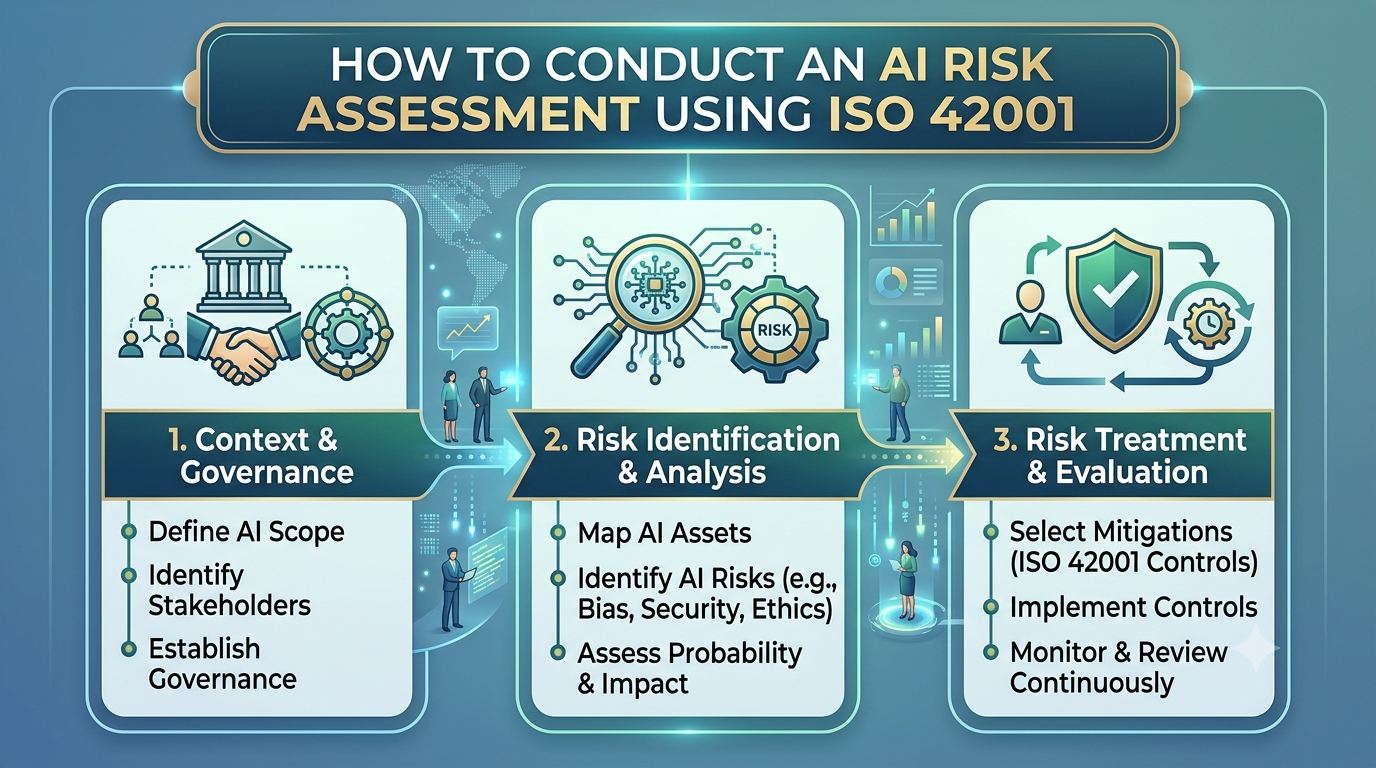
Artificial intelligence is transforming industries by improving efficiency, automation, and decision-making. However, AI systems also introduce risks related to privacy, security, bias, compliance, and transparency. Conducting an AI risk assessment is essential for organizations that want to deploy AI responsibly. ISO 42001 provides a structured framework for identifying, evaluating, and managing these risks through an artificial intelligence management system (AIMS).
Understand the Scope of the AI System
The first step is to define the AI system being assessed. Identify its purpose, intended users, data sources, stakeholders, and business objectives. Understanding the scope helps organizations determine where risks may arise throughout the AI lifecycle, from development to deployment and monitoring.
Identify Potential AI Risks
Next, list all possible risks associated with the AI system. Common AI risks include:
-
Bias and discrimination in AI decisions
-
Data privacy and security concerns
-
Lack of transparency or explainability
-
Regulatory and legal compliance issues
-
Model inaccuracies or unexpected outputs
-
Ethical concerns affecting customers or stakeholders
A comprehensive risk assessment considers both technical and organizational risks.
Evaluate Risk Severity and Likelihood
Once risks are identified, evaluate their potential impact and the likelihood of occurrence. Organizations can use a simple risk matrix to classify risks as low, medium, or high. Prioritizing risks ensures that resources are focused on the areas with the greatest potential business impact.
Define Risk Mitigation Measures
For each significant risk, establish appropriate controls and mitigation strategies. These may include:
-
Improving data quality and governance
-
Implementing access controls and cybersecurity measures
-
Conducting bias testing and model validation
-
Maintaining detailed AI documentation
-
Introducing human oversight for critical AI decisions
-
Regularly reviewing AI performance and outcomes
ISO 42001 encourages organizations to implement continuous monitoring rather than treating risk assessment as a one-time activity.
Document and Monitor the Assessment
Documentation is a key requirement of ISO 42001. Organizations should record identified risks, mitigation plans, responsibilities, review schedules, and monitoring activities. Continuous monitoring helps detect new risks as AI systems evolve or regulations change.
Align with ISO 42001 Requirements
An AI risk assessment should support the broader AI Management System defined by ISO 42001. This includes governance, leadership involvement, accountability, compliance, and continual improvement. By integrating risk management into daily operations, organizations can build trustworthy and responsible AI systems.
Organizations pursuing ISO 42001 Certification often begin by implementing a structured AI risk assessment process. It demonstrates a commitment to responsible AI governance while helping meet regulatory expectations and stakeholder trust.
Professionals looking to build expertise in AI governance can benefit from an ISO 42001 Course, which covers risk management principles, implementation guidance, and best practices for maintaining an AI Management System. Practical learning through ISO 42001 Training also helps teams understand how to identify AI risks, implement effective controls, and continuously improve AI governance across the organization.
Conclusion
AI risk assessment is no longer optional for organizations relying on artificial intelligence. Using ISO 42001 as a framework enables businesses to identify risks early, implement effective controls, and ensure responsible AI deployment. A structured approach not only strengthens compliance but also improves trust, transparency, and long-term success in AI adoption.

 English
 Arabic
 Français
 Español
 Português
 Deutsch
 Dutch
Dutch
 Italiano
 Russian
 Romaian